

That nagging toothache you’ve been ignoring for weeks? It might be telling you something important. Tooth pain is easy to dismiss as something that will pass on its own, but certain symptoms are your body’s way of signalling that something deeper is going on beneath the surface.
You’re not alone if you feel uncertain about what’s normal and what warrants a trip to the dentist. Many people put off seeking care because they’re unsure whether their discomfort is serious, or because they’ve heard that root canal treatment is something to dread. The good news is that modern dentistry has changed that story considerably, and recognising the signs you need a root canal early can actually make the entire process far more straightforward and comfortable than you might expect.
In this article, we’ll walk you through the key warning signs to watch for, explain what they mean for your oral health, and help you understand when it’s time to speak with a dentist. Whether you’re experiencing sensitivity, swelling, or persistent pain, knowing what to look for puts you in a much stronger position to protect your smile and get the right care at the right time.
Key Takeaways
- Knowing the signs you need a root canal – such as persistent tooth pain, lingering sensitivity, or visible swelling – can help you seek care before a minor issue becomes a major one.
- Root canal treatment is designed to save your natural tooth by removing infected pulp, and understanding the procedure can help ease any anxiety you may have about it.
- Modern advances in anaesthesia and technique mean root canal therapy is far more comfortable than its reputation suggests – you can explore Root Canal Therapy and preventative guides from U-First Dental Care to see how modern care is prioritised.
- Simple preventative habits, including regular dental check-ups and proper brushing and flossing, can significantly reduce your risk of ever needing a root canal in the first place.
- Acting promptly when symptoms arise gives you the best chance of a straightforward, successful outcome – and helps protect your smile for the long term.
Understanding Root Canals: What Are They and Why Are They Needed?
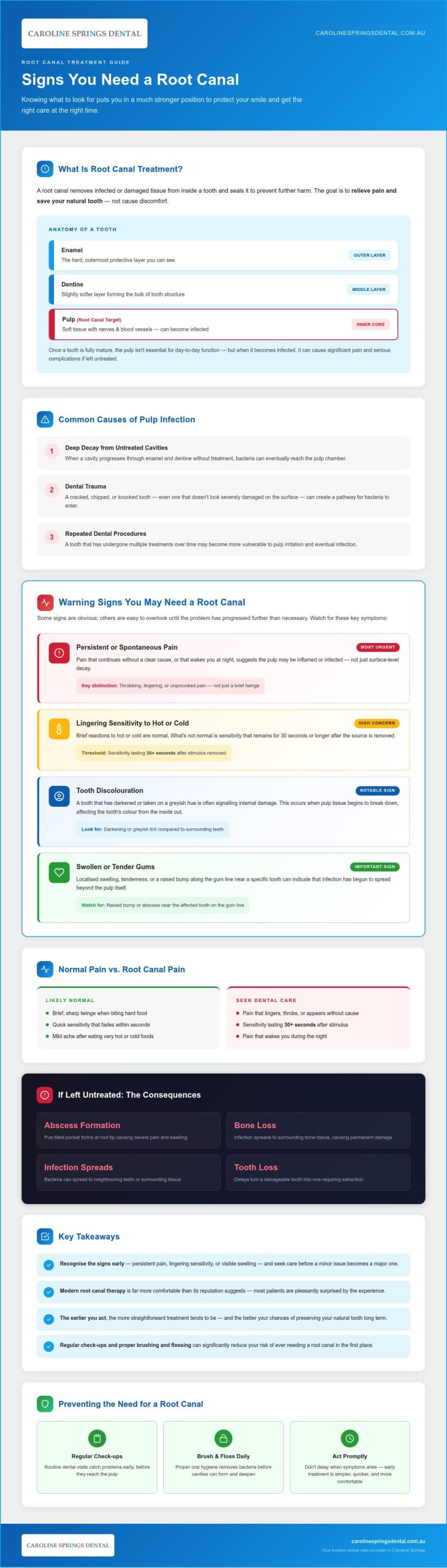
A root canal isn’t something most people plan for, but understanding what the procedure actually involves can take a lot of the fear out of it. At its core, root canal treatment is a restorative procedure designed to remove infected or damaged tissue from inside a tooth and seal it to prevent further harm. The goal isn’t to cause discomfort; it’s to relieve it, and to save a tooth that might otherwise need to be extracted entirely.
Anatomy of a Tooth: Understanding the Pulp
Your tooth is made up of three distinct layers. The outermost layer is enamel, the hard protective shell you can see. Beneath that sits dentine, a slightly softer layer that forms the bulk of the tooth structure. At the very centre lies the pulp, a soft tissue containing nerves, blood vessels, and connective tissue that helped your tooth develop and grow.
Once a tooth is fully mature, the pulp isn’t essential for its day-to-day function. The surrounding dentine and enamel can sustain the tooth without it. But when the pulp becomes infected or inflamed, it can cause significant pain and, if left untreated, lead to serious complications including abscess formation, bone loss around the tooth, and the spread of infection to neighbouring teeth or tissue.
Common Causes of Pulp Infection
Several situations can allow bacteria to reach the pulp and trigger infection. The most common include:
- Deep decay from untreated cavities: When a cavity progresses through the enamel and dentine without treatment, bacteria can eventually reach the pulp chamber.
- Dental trauma: A cracked, chipped, or knocked tooth, even one that doesn’t look severely damaged on the surface, can create a pathway for bacteria to enter.
- Repeated dental procedures: A tooth that has undergone multiple treatments over time may become more vulnerable to pulp irritation and eventual infection.
Recognising the signs you need a root canal early is closely tied to understanding these causes. The sooner an infection is identified, the more straightforward treatment tends to be, and the better your chances of preserving the natural tooth long term. Delaying care, on the other hand, allows the infection to deepen and can significantly complicate what might have been a simple procedure.
Timely treatment isn’t just about managing pain. It’s about protecting your overall oral health and avoiding the need for more extensive intervention down the track.
Recognising the Symptoms: Signs You Might Need a Root Canal
Your body rarely stays silent when something is wrong inside a tooth. The challenge is knowing which signals deserve attention and which are passing discomfort. Some of the signs you need a root canal are obvious; others are surprisingly easy to overlook until the problem has progressed further than it needed to.
Understanding Tooth Pain: When Is It Serious?
Not all tooth pain points to the same problem. A brief, sharp twinge when you bite down on something hard is different from pain that lingers, throbs, or appears without any obvious trigger. Root canal-related pain tends to have a few distinct qualities that set it apart from a standard toothache.
Watch for these specific patterns:
- Persistent or spontaneous pain: Pain that continues without a clear cause, or that wakes you at night, suggests the pulp may be inflamed or infected rather than simply irritated by surface-level decay.
- Sensitivity that lingers: It’s normal for teeth to react briefly to hot or cold food and drink. What’s not normal is sensitivity that stays for 30 seconds or longer after the source is removed. Lingering thermal sensitivity is one of the more reliable early indicators of pulp involvement.
- Discolouration of the tooth: A tooth that has darkened or taken on a greyish hue is often signalling internal damage. This can occur when the pulp tissue begins to break down, affecting the tooth’s colour from the inside out.
- Swollen or tender gums: Localised swelling, tenderness, or a raised bump along the gum line near a specific tooth can indicate that infection has begun to spread beyond the pulp itself.
If you’re experiencing severe or worsening pain, don’t wait it out. Book a consultation so the cause can be properly assessed before the situation escalates.
Other Indicators: What Else to Look For
Pain isn’t the only signal worth paying attention to. Several other physical changes can point toward pulp involvement, even in teeth that feel relatively comfortable day to day.
- Chipped or cracked teeth: Even a hairline crack can open a pathway for bacteria to reach the pulp over time. If a tooth has been damaged, it’s worth having it assessed promptly, regardless of whether it’s currently painful.
- A pimple on the gum: A small, recurring pimple-like bump on the gum near a tooth is often a dental abscess or fistula. It may drain fluid and temporarily relieve pressure, which can create a false sense that the problem has resolved. It hasn’t.
- Tooth mobility: A tooth that feels loose without any history of trauma or gum disease may be responding to bone loss caused by an advancing infection around the root.
These signs you need a root canal are easy to dismiss individually, but taken together, they paint a clearer picture. Early detection genuinely changes outcomes, and a straightforward assessment from a dentist can confirm whether treatment is needed before the situation becomes more complex to manage.
The Root Canal Procedure: What to Expect During Treatment
Understanding exactly what happens during a root canal can make a real difference to how you feel walking into the appointment. The procedure itself is methodical, well-established, and far more comfortable than most people anticipate. Here’s what the process actually looks like from start to finish.
Your dentist will begin by taking a digital X-ray of the affected tooth. This gives a clear picture of the root canal system, the extent of any infection, and the surrounding bone. It’s an essential step that shapes the entire treatment plan and ensures nothing is missed before any work begins.
Once the tooth has been assessed, local anaesthetic is administered to numb the area thoroughly. Most patients are genuinely surprised by how little they feel during the procedure itself. Any discomfort you may have been experiencing from the infection is typically far greater than anything you’d feel during treatment. When the anaesthetic has taken effect, your dentist will place a small protective sheet called a rubber dam around the tooth to keep the area clean and dry throughout.
The next stage involves carefully accessing the pulp chamber, then cleaning and shaping the root canal system using fine, specialised instruments. This removes the infected or inflamed tissue and prepares the canals for sealing. The canals are flushed with an antibacterial solution to eliminate remaining bacteria and reduce the risk of reinfection. Once cleaned and shaped, the canals are filled with a biocompatible material called gutta-percha and sealed. In most cases, a dental crown is recommended afterwards to protect and restore the tooth’s full function.
Before the Procedure: Preparation and Expectations
Your consultation is the right time to ask questions, share any concerns, and give your dentist a complete picture of your health history, including any medications you’re taking or conditions that might affect treatment. Your dentist may advise you to eat normally beforehand unless sedation is planned, and to avoid alcohol in the 24 hours prior. Coming in well-rested and informed helps everything go more smoothly.
Aftercare: Ensuring a Smooth Recovery
Recovery is generally straightforward. Some mild soreness or sensitivity in the days following treatment is normal and usually managed well with over-the-counter pain relief. Stick to soft foods while the area settles, and avoid chewing directly on the treated tooth until your permanent restoration is in place. Watch for signs that something needs attention, including increasing pain after the first few days, swelling that worsens, or a fever. These aren’t common, but they warrant a prompt call to your dentist.
Recognising the signs you need a root canal early means you’re more likely to arrive at this stage with a straightforward case, which typically translates to a faster procedure and an easier recovery overall. If you’d like to understand more about what root canal treatment involves at Caroline Springs Dental, the team is happy to walk you through every step before anything begins.
Pain-Free Options: Modern Advances in Root Canal Therapy
Ask almost anyone about root canals and you’ll hear the same thing: they’re painful, they’re something to dread, and if you can put it off, you should. That reputation is outdated, and it’s causing real harm. People who delay care because of fear often arrive at the dentist with a far more complicated situation than if they’d come in when they first noticed the signs you need a root canal. The truth is that modern root canal therapy has more in common with a routine filling than the ordeal most people imagine.
Dispelling Myths: Root Canal Pain and Reality
The biggest myth is that root canals hurt. In reality, the procedure doesn’t cause pain; it relieves it. The discomfort people associate with root canals typically comes from the infection itself, not the treatment. By the time a dentist begins working, effective local anaesthesia has already numbed the area thoroughly. Most patients report feeling pressure and movement during the procedure, but not pain. Many are genuinely surprised by how comfortable the experience is.
Modern dentistry has made significant strides in both anaesthetic delivery and technique. Finer needles, improved anaesthetic formulations, and a more gradual delivery approach mean that even the initial injection is far less confronting than it once was. Rotary endodontic instruments, which use flexible, motor-driven files rather than manual ones, have also made the cleaning and shaping process faster, smoother, and more precise. Less time in the chair and less tissue disruption both contribute to a more comfortable experience overall.
Choosing a practice that prioritises patient comfort and takes the time to explain each step before proceeding also makes a measurable difference. Feeling informed and in control reduces anxiety considerably. Learn more about our pain-free approach to root canal treatment at Caroline Springs Dental.
Sedation Dentistry: Is It Right for You?
For patients who feel anxious about dental treatment, sedation options offer an additional layer of reassurance. The most common option is happy gas, also known as nitrous oxide, which is inhaled through a small mask and produces a calm, relaxed feeling without putting you to sleep. It wears off quickly, meaning you can typically drive yourself home afterwards. Oral sedation, taken as a tablet before your appointment, provides a deeper sense of relaxation for those with more significant dental anxiety.
Sedation is worth considering if you:
- Feel strong anxiety or fear about dental procedures
- Have had a difficult experience with dental treatment in the past
- Struggle with a strong gag reflex
- Find it hard to sit still for extended periods
Both options are well-established and used safely in dental practices across Australia. Your dentist will review your health history and any medications you’re taking before recommending an approach, ensuring the choice is appropriate for your individual circumstances.
Recognising the signs you need a root canal is only half the picture. Knowing that the procedure itself can be genuinely comfortable, and that support is available if you’re feeling anxious, removes the final barrier between you and the care your tooth needs. If you’d like to talk through your options before committing to anything, book a consultation with the team at Caroline Springs Dental.
Preventing the Need for a Root Canal: Tips for Oral Health
The best outcome when it comes to root canal treatment is never needing one in the first place. While recognising the signs you need a root canal is genuinely valuable knowledge, building habits that reduce your risk from the outset is even more powerful. Prevention isn’t complicated, but it does require consistency, and the payoff for your long-term oral health is considerable.
Regular Check-ups: The Key to Prevention
Routine dental visits are your single most effective defence against problems that escalate into serious infection. Most adults benefit from seeing their dentist every six months, though your dentist may recommend a different schedule based on your individual risk profile, oral health history, or any ongoing concerns.
During a standard check-up, your dentist will examine your teeth and gums for early signs of decay, cracks, gum disease, and other issues that, if left unaddressed, can eventually compromise the pulp. Digital X-rays allow problems to be identified well before they become visible or symptomatic. Catching a small cavity early means a simple filling rather than a more involved procedure months down the track. It’s straightforward, preventative care that genuinely changes outcomes.
Book your routine check-up today and give your teeth the attention they deserve before minor issues have a chance to develop.
Oral Hygiene Best Practices
What you do at home between appointments matters just as much as what happens in the dental chair. A consistent daily routine keeps bacteria in check and significantly lowers your risk of the decay that can lead to pulp infection.
- Brushing technique: Brush for two minutes, twice a day, using a soft-bristled toothbrush and fluoride toothpaste. Hold the brush at a 45-degree angle to the gum line and use gentle, circular motions rather than scrubbing back and forth. Aggressive brushing wears down enamel over time, which is counterproductive.
- Flossing daily: Floss reaches the spaces between teeth that your toothbrush simply can’t access. Plaque that sits in these areas hardens into tartar and eventually leads to decay. Once a day is enough; the key is doing it consistently.
- Using mouthwash effectively: An antibacterial or fluoride mouthwash used after brushing and flossing adds an extra layer of protection. It’s not a substitute for mechanical cleaning, but it does help reduce bacteria and strengthen enamel in areas that are harder to reach.
Your diet plays a supporting role too. Limiting sugary and acidic foods and drinks reduces the fuel available for decay-causing bacteria. Drinking water throughout the day, particularly fluoridated tap water, helps rinse away food particles and supports enamel health.
If you notice anything unusual between appointments, including sensitivity, discomfort, or visible changes to a tooth, don’t wait for your next scheduled visit. Acting on early signs you need a root canal, or any dental concern, promptly is what keeps manageable problems from becoming complicated ones. The team at Caroline Springs Dental is here to help you stay ahead of issues, not just treat them after the fact. Get in touch to book an appointment at a time that suits you.
Take the Next Step Towards a Healthier Smile
Your teeth are worth looking after, and knowing the signs you need a root canal puts you in a genuinely stronger position to protect them. Persistent pain, lingering sensitivity, swelling, or a darkened tooth are all signals worth acting on rather than waiting out. The earlier you seek care, the more straightforward treatment tends to be.
At Caroline Springs Dental, you’ll find a family-friendly practice built around compassionate, preventative care and comprehensive restorative services. Whether you’re coming in with a concern or simply due for a check-up, the team is here to help you feel informed and comfortable every step of the way.
Don’t let uncertainty or anxiety hold you back from the care your smile deserves. Schedule your consultation with our caring team today and take the first step towards lasting oral health with a team that genuinely has your best interests at heart.
Frequently Asked Questions About Root Canal Treatment
What are the main signs that indicate a root canal is needed?
The most common signs you need a root canal include persistent or spontaneous tooth pain, sensitivity to hot or cold that lingers well after the source is removed, a darkened or discoloured tooth, and localised swelling or tenderness along the gum line. A small pimple-like bump on the gum near a specific tooth, or a tooth that feels unexpectedly loose, can also point to underlying infection requiring treatment.
These symptoms don’t always appear together, and some people experience very little discomfort even when infection is present. That’s why regular dental check-ups matter so much. A dentist can identify problems through examination and X-rays before symptoms become severe.
Does a root canal procedure hurt?
Most patients are genuinely surprised by how comfortable root canal treatment is. The procedure is performed under local anaesthesia, which thoroughly numbs the area before any work begins. What you’ll typically feel is pressure and movement, not pain. The discomfort people associate with root canals usually comes from the infection itself, not the treatment designed to resolve it.
For patients who feel anxious, sedation options such as nitrous oxide (happy gas) or oral sedation are available and can make the experience considerably more relaxed. Modern techniques and instruments have also made the process faster and less invasive than it once was.
How long does a root canal treatment take?
Most root canal treatments are completed in one to two appointments, each lasting roughly 60 to 90 minutes depending on the complexity of the tooth’s root canal system. Straightforward cases involving a single-rooted tooth tend to be quicker, while molars with multiple canals may require a little more time. Your dentist will give you a clearer estimate after reviewing your X-rays and assessing the tooth.
A follow-up appointment is typically needed to place a permanent crown over the treated tooth, which restores its full strength and function. Planning for this from the outset helps you manage your schedule without any surprises.
Can a root canal treatment save my tooth?
Yes, saving your natural tooth is precisely the goal of root canal treatment. By removing the infected pulp, cleaning the canal system, and sealing the tooth, the procedure eliminates the source of infection while preserving the tooth’s structure. With a well-fitted crown placed afterwards, a root canal-treated tooth can function normally and last many years with proper care.
Keeping your natural tooth is generally preferable to extraction. It maintains your bite alignment, supports the surrounding teeth, and avoids the need for a replacement option such as an implant or bridge, which involves additional treatment and cost.
What happens if I delay getting a root canal?
Delaying treatment allows the infection to spread beyond the pulp and into the surrounding bone and tissue. What might have been a straightforward procedure can become significantly more complex, and in some cases the tooth may no longer be salvageable. An untreated dental abscess can also cause broader health complications if the infection spreads to neighbouring structures.
Pain may temporarily subside if the pulp dies, but that doesn’t mean the problem has resolved. Infection can continue silently, causing bone loss and increasing the risk of harm to adjacent teeth. Acting promptly when you notice the signs you need a root canal gives you the best chance of a simpler, more successful outcome.
How can I prevent the need for a root canal?
Consistent daily oral hygiene is your strongest defence. Brushing twice a day with fluoride toothpaste, flossing daily, and using an antibacterial mouthwash helps keep decay-causing bacteria under control. Limiting sugary and acidic foods reduces the risk of cavities progressing deep enough to reach the pulp. Wearing a mouthguard during contact sport also protects teeth from the kind of trauma that can lead to pulp damage over time.
Routine dental check-ups allow your dentist to catch small problems before they develop into something more serious. A minor cavity identified early is a filling, not a root canal. Staying on top of your appointments is genuinely one of the simplest things you can do for your long-term oral health.
Are there any alternatives to a root canal?
In some cases, tooth extraction is the only alternative if root canal treatment isn’t appropriate or the tooth is too damaged to restore. However, extraction comes with its own considerations: the gap left behind can cause neighbouring teeth to shift, affect your bite, and may need to be addressed with a dental implant, bridge, or denture, each involving further treatment.
Where the tooth can be saved, root canal treatment is generally the preferred option because it preserves what’s already there. Your dentist will assess your specific situation and discuss which approach best suits your oral health needs and long-term goals before any decision is made.