


It’s a sunny Saturday afternoon at the local footy oval when a sudden collision leads to every parent’s nightmare: a tooth lying on the grass. You’re likely feeling a rush of adrenaline and panic, wondering exactly what to do for a knocked out tooth to ensure your child’s smile isn’t changed forever. It’s completely normal to feel overwhelmed in the heat of the moment, especially when you aren’t sure if you’re looking at a baby tooth or a permanent one.
Knowing the correct steps to take in the first 30 minutes is the most important factor in saving a tooth. This guide outlines the precise, life-saving actions to take immediately to ensure a successful recovery and find quick pain relief. We will walk you through the correct handling techniques, the specific storage methods recommended by Australian dental authorities, and how to navigate emergency restorative care right here in Melbourne. By the end of this article, you’ll have a clear, calm plan to protect your family’s smiles when every second counts.
Key Takeaways
- Act quickly within the first 30 minutes and follow our checklist on what to do for a knocked out tooth to give the root the best chance of survival.
- Always handle the tooth by the crown rather than the root and keep it moist in a container of cold milk or saline while travelling to the clinic.
- Identify whether the lost tooth is a primary or permanent one, as reinserting a baby tooth can cause lasting damage to the adult tooth underneath.
- Prepare for your emergency appointment by understanding how dentists use X-rays and professional stabilisation to secure a displaced tooth.
- Learn about modern restorative care, including dental implants and bridges, to maintain your confidence if a tooth is lost permanently.
Immediate Actions: The 5-Step Emergency Checklist
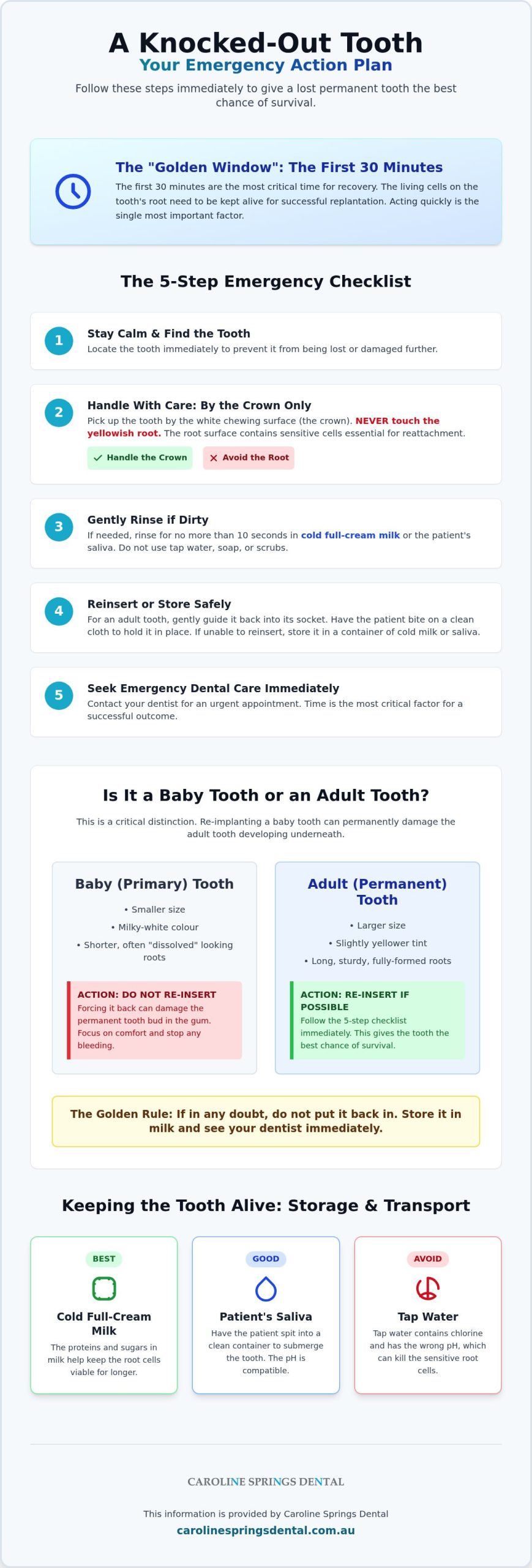
When an accident happens on the playground or the sports field, the clock starts ticking immediately. Clinical experts often refer to the first 30 minutes as the “Golden Window” for dental recovery. This is because the living cells on the root surface begin to perish once they are separated from the blood supply and nerves. If you’re feeling panicked about what to do for a knocked out tooth, your primary goal is to keep those delicate cells alive while you make your way to a professional.
A tooth that has been completely displaced from its socket is clinically known as Dental avulsion. To give the tooth the best chance of successful replantation, follow this immediate 5-step checklist:
- Stay calm and find the tooth: Look for it immediately to avoid it being stepped on or lost in the grass.
- Handle with care: Always pick up the tooth by the crown, which is the white part you use for chewing. Never touch the yellowish root.
- Rinse if necessary: If the tooth is visibly dirty, rinse it for no more than 10 seconds in cold full-cream milk or the patient’s own saliva.
- Reinsert or store: Try to place the tooth back into the socket immediately. If that isn’t possible, keep it moist in milk or saliva.
- Seek help: Contact a provider of emergency dentistry right away for an urgent appointment.
Handling and Rinsing the Tooth Safely
It’s vital that you don’t scrub the tooth or use any soap, chemicals, or toothpastes. The root is covered in a sensitive layer called the periodontal ligament, which is essential for the tooth to reattach to the jawbone. You should also avoid using tap water for more than a quick second. Tap water contains chlorine and has a different pH level than your body, which can cause the root cells to swell and burst. If you don’t have milk handy, the patient can spit into a small container to keep the tooth submerged in their own natural fluids.
Reinserting the Tooth into the Socket
If the patient is an adult or an older child, try to guide the tooth back into its original position. Ensure it’s facing the right way and gently push it into the socket until it’s level with the other teeth. To hold it steady, have the patient bite down gently on a clean handkerchief or a piece of sterile gauze. Don’t force it if there’s significant resistance or if the jaw feels broken. If the tooth won’t slide back in easily, place it in a cup of milk and head straight to the clinic. Knowing what to do for a knocked out tooth in these first few minutes can be the difference between a simple replantation and needing a permanent replacement later in life.
Is it a Baby Tooth or an Adult Tooth?
In the heat of the moment, figuring out what to do for a knocked out tooth depends entirely on whether the tooth is a “baby” (primary) or an “adult” (permanent) one. It’s a common source of anxiety for Melbourne parents. If your child is between the ages of 6 and 12, they likely have a mix of both, making identification tricky during an emergency.
Adult teeth generally begin to appear around age 6, starting with the first molars at the back and the lower central incisors at the front. By age 7 or 8, the upper front teeth usually follow. These permanent replacements are typically larger, have a slightly yellower tint compared to the milky-white of baby teeth, and often feature jagged edges. Knowing what to do for a knocked out tooth when you aren’t certain of its type can prevent accidental harm.
The Golden Rule is simple: if you are in any doubt, do not try to put the tooth back into the socket. Instead, place it in a container of cold full-cream milk and call us. According to UK NHS guidance, you should never try to re-plant a baby tooth because you risk damaging the developing permanent tooth bud sitting directly beneath the gum line. Forcing a primary tooth back in can lead to infection or structural issues for the adult tooth waiting to erupt.
Signs of a Permanent (Adult) Tooth
Look closely at the biting edge. New adult teeth have distinctive ridges known as mamelons that help them break through the gums; these ridges eventually wear down with use. Permanent teeth also have much longer, sturdier roots compared to baby teeth, which often have “dissolved” roots if they were nearly ready to fall out naturally. If the tooth looks substantial, textured, and slightly off-white, treat it as an adult tooth.
What to Do if a Baby Tooth is Knocked Out
If it’s definitely a baby tooth, your focus should shift to comfort and wound care. Use a clean, cold compress to manage swelling and stop any bleeding. While the tooth itself doesn’t need to be saved, an emergency dental visit is still necessary. We need to ensure no fragments are left in the gum and check for any hidden damage to the surrounding bone. Our team is highly experienced in children’s dentistry and can help monitor for future spacing issues to ensure their adult smile erupts correctly.
Storage and Transport: Keeping the Tooth Alive
The biological success of replanting a tooth depends almost entirely on the health of the periodontal ligament cells attached to the root. These cells are incredibly delicate; if they dry out, they begin to die within minutes. When you are deciding what to do for a knocked out tooth, your primary objective is to maintain a moist, pH-balanced environment that mimics the conditions inside the mouth. If these cells remain viable, there is a significantly higher chance that the tooth will successfully fuse back into the jawbone once it is professionally splinted.
A common mistake is wrapping the tooth in a dry tissue or a handkerchief. This actually accelerates cell death by wicking moisture away from the root surface. Similarly, avoid using tap water for long-term storage. The chlorine and lack of essential minerals in tap water can cause the root cells to swell and burst. For the best outcome, follow the emergency steps for a knocked-out tooth and place it in a small, clean container submerged in a suitable liquid for the drive to our Caroline Springs clinic.
Why Milk is the Gold Standard for Tooth Storage
Cold full-cream milk is widely considered the best storage medium because its chemical makeup, including its pH level and protein content, is remarkably compatible with human cells. It provides the necessary nutrients to keep the root “alive” for up to six hours. For local Melbourne sports clubs or schools, keeping a small carton of long-life milk in the first aid kit is a brilliant, low-cost way to prepare for dental trauma. If the patient has a dairy allergy or milk isn’t available, a sterile saline solution from a chemist is a reliable alternative.
Alternative Storage: Saliva and Plastic Wrap
If you find yourself without milk or saline, the patient’s own saliva is the next best thing. An adult can safely store the tooth in their “buccal vestibule,” which is the space between the cheek and the lower gums. This keeps the tooth at the correct temperature and bathed in natural protective fluids. However, this method is never recommended for young children due to the high risk of them accidentally swallowing or choking on the tooth. In a pinch, wrapping the tooth in plastic cling wrap can act as a temporary moisture barrier to prevent the root from dehydrating while you search for a better storage liquid or head straight to an emergency dental appointment.
What to Expect at Your Emergency Dental Appointment
Once you arrive at our Caroline Springs clinic, the focus shifts from immediate first aid to clinical preservation. You’ve already handled the critical first steps of what to do for a knocked out tooth, and now our team takes over to give the tooth its best chance at a long-term recovery. Our priority is to lower the patient’s anxiety and manage any pain before we begin the technical work of replantation.
We start with a rapid assessment, which includes digital X-rays to look for hidden jaw fractures or damage to the surrounding bone. We’ll also thoroughly numb the area so the patient feels comfortable and calm during the procedure. We then gently clean the tooth and the socket, removing any debris while being careful not to damage the living cells on the root surface. Once the tooth is carefully guided back into its original position, we apply a flexible splint. This is a thin, inconspicuous wire bonded to the injured tooth and its stable neighbours, acting like a temporary brace to keep everything steady while the tissues heal.
The Splinting and Healing Phase
The splint usually stays in place for one to two weeks, though this can vary depending on the severity of the injury. During this time, the periodontal ligament begins the delicate process of reattaching to the jawbone. It’s essential to follow a soft food diet to avoid putting pressure on the healing tooth. We recommend sticking to nutritious options like smoothies, yoghurt, and well-cooked pasta. We will schedule a follow-up visit shortly after the initial appointment to monitor the stabilisation and ensure the gums are healing without signs of infection.
Potential Complications and Root Canal Therapy
Because the blood supply and nerves were severed during the accident, the internal “pulp” of the tooth often cannot survive. This is why many avulsed teeth eventually require root canal treatment to prevent abscesses and pain. At home, keep a close watch for any darkening or grey discolouration of the tooth, which is a common sign the pulp is no longer healthy. We also monitor for a condition called resorption, where the body’s immune system begins to reject and “eat away” the tooth root. Catching these signs early through regular check-ups is vital for ensuring the tooth remains a functional part of your smile for years to come.
If you are currently facing a dental crisis, please book an emergency appointment immediately so we can begin this restorative process for you.
Long-term Solutions and Preventing Future Injuries
Sometimes, even when you follow every instruction on what to do for a knocked out tooth, the biological damage is too severe for the tooth to survive. This can happen if the tooth was out of the mouth for too long or if the root was damaged upon impact. While this news is disappointing, modern restorative dentistry ensures that a lost tooth doesn’t have to mean a permanent gap in your smile. Our team focuses on results that look, feel, and function just like your natural teeth, ensuring your confidence remains intact.
According to the Australian Dental Association, 40% of Australian dental injuries are sports-related. This high figure highlights why we prioritise both immediate repair and long-term prevention. Whether the injury happened on the local footy field or during a weekend bike ride, we’re here to help you navigate the next steps with empathy and professional expertise.
Restoring Your Smile: Implants and Bridges
If a permanent tooth is lost, dental implants are widely considered the gold standard for replacement. An implant acts as a titanium artificial root, providing a sturdy foundation for a custom-made crown that matches the colour and shape of your surrounding teeth. Because they integrate with the jawbone, they help prevent bone loss and maintain your facial structure over time. For patients who prefer a non-surgical option, dental crowns and bridges offer a reliable way to bridge the gap. A bridge uses the neighbouring teeth as anchors to support a high-quality porcelain replacement. During a consultation at our Caroline Springs clinic, we’ll help you decide which path is best for your lifestyle and long-term oral health.
Prevention for Athletes in Melbourne’s West
The best way to manage a dental emergency is to prevent it from happening in the first place. Whether your children play footy in Burnside or basketball in Taylors Hill, a custom-fitted mouthguard is their best line of defence. Many parents rely on “boil-and-bite” versions from the local chemist, but these often provide inferior protection. They are often bulky, can interfere with breathing, and frequently slip out of place during a collision. In fact, 2023-2024 data shows that cycling, AFL, and soccer are the leading causes of sports-related hospitalisations in Australia, yet only 36% of Australians wear a mouthguard during sport.
A custom mouthguard from Caroline Springs Dental is moulded specifically to your child’s unique bite. This ensures a snug fit that absorbs and distributes the force of an impact, significantly reducing the risk of tooth avulsion. We regularly organise mouthguard fittings for local clubs across Deanside and the surrounding suburbs. It’s a small investment that provides immense peace of mind. Knowing what to do for a knocked out tooth is essential, but preventing the injury altogether is always the preferred outcome for any active Melbourne family.
Protecting Your Family’s Smile for the Future
Facing a dental emergency is never easy, but being prepared makes all the difference. We have explored the critical importance of the “Golden 30 Minutes,” the proper way to store a tooth in milk, and why custom mouthguards are the ultimate defence for active kids in Melbourne’s West. Knowing exactly what to do for a knocked out tooth can transform a stressful accident into a manageable situation with a positive outcome.
At Caroline Springs Dental, we prioritising urgent cases with dedicated emergency appointments to ensure you receive care when it matters most. Our team is trusted by families across Burnside, Taylors Hill, and Deanside for our expertise in both immediate restorative dentistry and permanent solutions like dental implants. We are here to support your family’s long-term health journey with gentle, professional care that puts your comfort and confidence first. Whether you need urgent assistance or want to discuss a personalised plan for long-term restoration, we are ready to help. Please Contact Caroline Springs Dental for Emergency Care to secure your appointment. We’re committed to helping you maintain a healthy, beautiful smile for a lifetime.
Frequently Asked Questions
Can a tooth be put back in after 2 hours?
Yes, a dentist can still attempt to replant a tooth after two hours, but the chances of long term success are significantly lower. By this stage, the delicate cells on the root surface have likely perished. While the tooth might be stabilised in the socket, it often requires a root canal and may eventually be rejected by the body. We recommend seeking professional help as soon as possible to explore all available options.
How much does it cost to fix a knocked-out tooth in Australia?
The cost varies depending on whether you access public or private care and the complexity of the injury. In Victoria, eligible concession card holders pay a flat fee of $32.00 for public emergency dental care. Private emergency consultations in Melbourne generally range from $120 to $300, excluding the cost of treatment. Many children are eligible for the Child Dental Benefits Schedule, which provides up to $1,132 in benefits over two years for essential services.
What happens if I swallow my knocked-out tooth?
Swallowing a tooth is usually not a medical emergency, as the tooth will typically pass through your digestive system without causing harm. The primary concern is ensuring the tooth wasn’t inhaled into the lungs, which would cause coughing or difficulty breathing. If the tooth is swallowed and lost, the focus shifts to restorative care. We can discuss options like dental bridges or implants to fill the gap and maintain your bite alignment.
Is a knocked-out tooth a dental emergency?
A knocked-out adult tooth is one of the most time-sensitive dental emergencies you can face. Immediate action is required to keep the root cells alive and increase the chances of successful replantation. If you are unsure what to do for a knocked out tooth, the most important step is to keep the tooth moist and contact an emergency dentist immediately. Prompt treatment is essential for pain relief and preventing permanent tooth loss.
Will my insurance cover a replanted tooth or dental implant?
Coverage depends on your specific private health insurance provider and your level of extras cover. Most policies with “Major Dental” benefits provide rebates for restorative treatments such as crowns or dental implants, while basic policies might only cover the initial emergency assessment. It is a good idea to contact your insurer directly to confirm your entitlements for accidental dental injuries and any waiting periods that might apply to your policy.
Can a dentist save a tooth that has been knocked out for a day?
It is extremely rare to successfully save a tooth that has been out of the mouth for a full day. By this point, the periodontal ligament cells are dead, and the risk of severe infection or the body rejecting the tooth is very high. Instead of replanting, we generally recommend moving straight to modern replacement options. This ensures a predictable outcome and prevents the pain associated with a failing replanted tooth.
What is the success rate of replanting a permanent tooth?
The success rate is highest when what to do for a knocked out tooth is handled correctly within the first 30 to 60 minutes. Research shows that immediate replantation significantly improves the likelihood of the tooth reattaching to the jawbone. Success also depends on proper storage in milk and ensuring the root was not touched or scrubbed. While no procedure is guaranteed, acting quickly provides the best possible prognosis for your natural smile.