


Have you ever considered that a single missing or damaged tooth is less about your appearance and more about the structural health of your entire mouth? When a tooth is compromised, it is not just your smile that suffers; your ability to enjoy a meal and the alignment of your surrounding teeth are also at risk. If you have been finding it difficult to chew your favourite foods or feel the need to cover your mouth when you laugh, you are not alone. We understand that the thought of a clinical procedure can be daunting, but modern dental crown and bridge restoration is designed to be a comfortable, life-changing solution rather than a source of anxiety.
We agree that you deserve a functional, pain-free bite and a smile that looks and feels completely natural. This complete 2026 guide will help you discover how advanced crown and bridge restorations can protect your teeth and revitalise your confidence with expert care from your local community clinic. We will walk you through the differences between these two essential treatments, the high-quality materials like Zirconia now available, and exactly what to expect during your visit. By the end of this article, you will have a clear path toward a healthier, more radiant smile that blends seamlessly with your natural teeth.
Key Takeaways
- Learn how modern dental crown and bridge restoration techniques protect your existing teeth while effectively closing gaps in your smile.
- Discover the latest high-strength materials, such as Zirconia and ceramics, that ensure your new restoration looks and feels like a natural tooth.
- Understand the step-by-step clinical journey, from the initial consultation to the final fitting, designed for maximum comfort and minimal anxiety.
- Compare the benefits of traditional bridges against dental implants to decide which timeframe and approach best suits your recovery goals.
- Find out how a personalised, community-focused approach at our Caroline Springs centre can help you regain a functional, pain-free bite.
Understanding Dental Crown and Bridge Restoration: More Than Just a Smile Makeover
Restoring your smile involves more than just filling a gap or covering a chip. It is about re-establishing the oral architecture that keeps your mouth healthy and your bite balanced. A dental crown and bridge restoration is a sophisticated approach to dental health that addresses both the look of your teeth and their essential function. When a tooth is lost or severely weakened, the surrounding teeth often begin to shift into the empty space. This movement can lead to a misaligned bite, jaw pain, and even further tooth loss. By choosing a restorative solution, you are making a strategic investment in the long-term stability of your smile.
The Dental Crown: Your Tooth’s Protective Helmet
Think of a dental crown as a custom-fitted, high-strength helmet for a vulnerable tooth. We often recommend a crown when a tooth has been weakened by a large filling, a deep crack, or following root canal therapy. Unlike a standard filling that sits inside the tooth, a crown encases the entire visible portion above the gum line. This design allows the crown to distribute biting forces evenly across the tooth structure, which helps prevent fractures during everyday activities like eating. Modern materials ensure these restorations look indistinguishable from your natural enamel, giving you a result that feels as good as it looks.
The Dental Bridge: Bridging the Gap for Missing Teeth
If you are missing one or more teeth in a row, a dental bridge offers a fixed, reliable solution. But what is a dental bridge? Essentially, it consists of a “pontic” (a realistic false tooth) held in place by “abutments” (crowns placed on the healthy teeth on either side of the gap). This configuration creates a sturdy, permanent fixture that restores your ability to chew naturally and speak clearly without the worry of a prosthetic slipping. Beyond the immediate functional benefits, bridges also provide crucial support for your lips and cheeks. This helps maintain your natural facial structure, preventing the “sunken” appearance that sometimes occurs after tooth loss.
Choosing between these options depends on your specific needs, but both play a vital role in maintaining your oral health. Whether you need to reinforce a single tooth or replace several, these restorations ensure your bite remains aligned. This prevents the chain reaction of dental issues that can arise from neglected gaps or brittle teeth. At our clinic, we focus on providing a dental crown and bridge restoration that feels like a natural part of you. We take the time to ensure the fit is precise so you can leave our chair feeling confident and cared for.
Materials and Technology: Choosing the Right Restoration for Your Lifestyle
Selecting the right material for your dental crown and bridge restoration is a decision that balances your aesthetic goals with the practical demands of your daily life. Not all teeth perform the same role; your front teeth are the stars of your smile, while your back molars act as the heavy lifters of your digestive system. Because of this, the choice of material depends heavily on the tooth’s location and the intensity of your bite force. We’ve seen a significant evolution in dental technology, moving away from traditional dark metals toward advanced ceramics that mimic the natural translucency and light-reflecting qualities of real enamel.
Modern materials are prioritised for their biocompatibility, which is essential for maintaining long-term gum health. When a material is biocompatible, it integrates harmoniously with your soft tissues, preventing the irritation or dark grey lines at the gumline that were common with older techniques. As noted by the American Dental Association on crowns, these restorations are vital for restoring a tooth’s shape, size, and strength. Our goal is always to provide a solution that feels as natural as it looks, ensuring you can eat and speak without a second thought.
Porcelain and Zirconia: The Gold Standard for Aesthetics
For many patients in the Western Suburbs, Zirconia has become the go-to material for its incredible fracture toughness and lifelike appearance. It is a type of ceramic that is virtually indestructible, making it ideal for both front and back teeth. Porcelain is another popular choice, especially for the “social six” teeth at the front of the mouth. It offers a level of detail in colour matching that is truly impressive. Both materials are highly resistant to staining from coffee or tea, ensuring your investment stays bright and beautiful for years to come.
Metal and Gold Alloys: Strength Where It Matters Most
While ceramics are the most popular choice for their looks, gold or metal alloys still serve a critical purpose in restorative dentistry. For back molars that endure the brunt of heavy chewing or teeth grinding, gold is often the most resilient option available. Gold is exceptionally gentle on the opposing natural teeth, meaning it won’t cause premature wear to your enamel. Although there is an aesthetic trade-off with metal, the longevity and structural integrity of these alloys are difficult to surpass for those who prioritise durability above all else.
We take great pride in our meticulous colour-matching process, using detailed shade guides to ensure your new restoration blends perfectly with your existing teeth. If you are ready to see how these modern materials can transform your oral health, we invite you to explore our restorative options and find the perfect fit for your smile.
The Clinical Journey: What to Expect During Your Procedure
Many people feel a flutter of nerves when they think about dental work. We want you to know that your comfort is our absolute priority throughout the dental crown and bridge restoration process. Most patients are surprised by how straightforward the journey is. Typically, it takes just two visits to our Caroline Springs centre to complete your transformation. From the moment you sit in the chair, we use a gentle local anaesthetic to ensure the entire procedure is pain-free. This approach allows even our most anxious patients to feel relaxed while we work to restore their health and confidence.
The Preparation Phase: Impressions and Temporaries
During your first appointment, we focus on preparing the foundation. We gently reshape the tooth to make space for the new restoration. This ensures the final piece sits flush with your gum line and feels natural. Next, we take a precision impression. Whether we use traditional putty or advanced digital scanners, this step is vital for the laboratory to craft a perfect match. As this Cleveland Clinic guide to dental crowns explains, the preparation is the key to a long-lasting result. We’ll then place a temporary restoration to protect your tooth while your permanent one is being made. It’s best to avoid sticky or very hard foods on that side of your mouth for the next fortnight to keep the temporary secure.
The Final Fit: Achieving a Seamless, Natural Look
Your second visit is the most exciting part of the journey. This is when we swap your temporary for the permanent, custom-made piece. We meticulously check the fit, the way your teeth meet when you bite, and the colour match against your natural enamel. Once we are both completely happy with the result, we use a high-strength bonding agent to secure the restoration in place. This bond is incredibly durable, allowing you to return to your normal routine with confidence. For the first 24 hours after your dental crown and bridge restoration is fitted, your gums might feel slightly tender. We suggest following these simple tips to ensure the best start for your new smile:
- Avoid very hot or cold drinks if you experience mild sensitivity.
- Stick to softer foods like pasta or yoghurt to let the bonding set fully.
- Brush gently around the new restoration to keep the area clean.
- Contact us if your bite feels uneven once the anaesthetic wears off.
If you have any questions about the process or want to discuss your options, our team is always here to help you feel at ease. You can learn more about our approach to dental crowns and bridges or book your initial consultation today to get started on your journey to a better smile.
Making the Choice: Dental Bridge vs. Implant-Supported Restorations
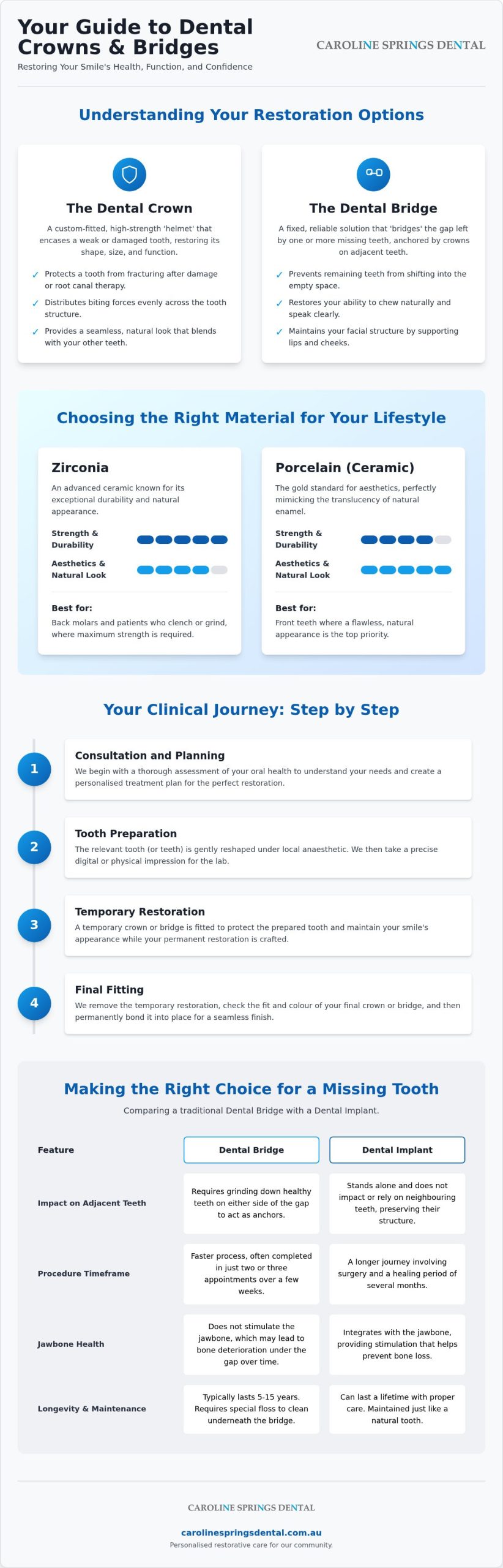
Deciding how to replace a missing tooth often comes down to your personal priorities, budget, and oral health status. While dental implants are a popular modern choice, a traditional dental crown and bridge restoration remains a highly effective and frequently preferred alternative for many of our patients. The primary difference lies in the approach. Implants require a surgical procedure to place a titanium post into the jawbone, which acts as an artificial root. In contrast, a bridge is non-invasive. It relies on the support of your existing teeth rather than surgery, making it a gentler option if you feel anxious about clinical procedures.
If you’re looking for a swift result, the bridge wins on speed. An implant process can span several months to allow the bone to bond with the post. A bridge is typically completed in just two to three weeks. This makes it an excellent choice for patients who want to restore their smile’s function and aesthetics quickly. Beyond speed, bridges are often a more cost-effective solution upfront, providing a high-quality result without the need for specialist surgical fees or long recovery periods.
When a Traditional Bridge is the Ideal Choice
A traditional bridge is often the best path forward if you’ve experienced bone loss in your jaw. Implants require a certain level of bone density to remain stable. If your bone structure isn’t sufficient, you might need a bone graft first, which adds more time and complexity to your treatment. Additionally, if the teeth on either side of the gap are already heavily filled or damaged, a bridge serves a dual purpose. It fills the gap while simultaneously providing protective crowns for those adjacent teeth. It’s a practical, multi-tasking solution that addresses several dental needs at once.
Considering Long-Term Durability and Oral Health
Maintenance is another key factor to weigh up. Cleaning an implant is very similar to cleaning a natural tooth, but a bridge requires a slightly different technique. You’ll need to use specific flossing tools to clean under the false tooth to keep the gums healthy. In terms of longevity, a well-maintained dental crown and bridge restoration can last 10 to 15 years with proper care. While implants often have a longer lifespan, the non-surgical nature and immediate results of a bridge make it a compelling option for many families in our community. For those curious about the surgical alternative, you can read more on our Dental Implants Caroline Springs page.
If you’re unsure which path is right for your unique situation, our team is here to guide you through the pros and cons of each. We invite you to book a consultation at our centre to discuss your restorative options in a relaxed, friendly environment.
Restorative Care at Caroline Springs Dental: Personalised Treatment for Our Community
At Caroline Springs Dental, we believe that your oral health is a lifelong journey. As a family-focused clinic serving Caroline Springs and neighbouring suburbs like Melton and Deanside, we don’t just see patients; we see neighbours. We understand that visiting the dentist can be a source of stress for many, which is why we’ve built our practice around the concept of gentle dentistry. Whether you are coming in for a routine check-up or a complex dental crown and bridge restoration, our goal is to make you feel completely at home. Our team is dedicated to lowering the anxiety often associated with dental visits by providing a warm, community-focused environment where you are always respected.
We take a holistic view of your dental well-being. A restoration isn’t a standalone fix; it’s a vital component of a comprehensive Family Dentist Caroline Springs plan. By looking at the bigger picture, we ensure that your new crown or bridge works in harmony with the rest of your mouth. This strategic approach supports your long-term health and prevents the chain reaction of issues that can occur when a single tooth is left compromised. We encourage all local residents to book a consultation to discuss their unique smile goals in a space that feels reliable and accessible.
Our Approach to Restorative and General Dentistry
Our clinical team is committed to meticulous craftsmanship and the use of high-quality materials. We don’t believe in one-size-fits-all solutions. Instead, we focus on precision and individual attention to ensure your dental crown and bridge restoration looks natural and lasts for years. We prioritise patient education because we want you to be an active partner in your health journey. You won’t find cold, clinical detachment here. We take the time to explain every step, ensuring you feel confident and informed. You can learn more about our team and the values that drive our practice on our About Us page.
Integrating Restoration into Your Family’s Preventative Plan
Many people delay restorative work because they aren’t in immediate pain, but being proactive is the best way to avoid more complex treatments. Addressing a cracked or weakened tooth with a crown now can often prevent the need for a Root Canal Treatment later. We provide this level of foresight for the whole family. Our services range from preventative sealants in Children’s Dentistry to durable restorations for seniors. To ensure that quality dental care remains within reach for our community, we invite you to explore our various Payment Options. We work with you to make your health a priority without the added stress of financial uncertainty.
Take the Next Step Toward Your Healthiest Smile
Choosing a dental crown and bridge restoration is about more than just aesthetics; it’s a vital commitment to your long-term health and comfort. We’ve explored how modern materials like Zirconia offer incredible durability, while our gentle clinical approach ensures your journey is as stress-free as possible. Whether you’re reinforcing a single tooth or bridging a gap, these solutions are designed to blend perfectly with your natural smile and restore your ability to eat and speak with total confidence.
As your trusted local dental centre in Caroline Springs, we’re dedicated to providing gentle care for nervous and family patients across the Western Suburbs. You don’t have to live with the discomfort of missing or damaged teeth. Our team prioritises your well-being, using high-quality, durable restorative materials to ensure your results are both beautiful and long-lasting.
If you’re ready to revitalise your smile and protect your oral health for years to come, we’re here to guide you every step of the way. Book your restorative consultation at Caroline Springs Dental today. We look forward to helping you smile with renewed confidence.
Frequently Asked Questions
How long does a dental crown or bridge restoration typically last?
A high-quality dental crown and bridge restoration is expected to last between 10 and 15 years with proper oral hygiene and regular check-ups. Factors like the material used and your biting habits play a significant role in its longevity. To get the most out of your restoration, we recommend avoiding habits like ice-chewing. Regular professional cleans at our centre help us monitor the condition of the bonding and underlying tooth structure over time.
Is the procedure for getting a crown or bridge painful?
No, the procedure is not painful because we use local anaesthetic to completely numb the area before we begin. Most patients describe the sensation as a bit of pressure rather than discomfort. We specialise in gentle dentistry for nervous patients, so we take our time to ensure you feel relaxed throughout the visit. After the anaesthetic wears off, you might feel some mild tenderness in the gums, but this usually settles within 24 hours.
How do I care for my new dental bridge to ensure it stays in good condition?
Caring for your bridge requires a slightly different routine than natural teeth, specifically focusing on the area underneath the false tooth. You should use a bridge needle or specialised floss to remove food particles and plaque from the gap between the bridge and your gums. Brushing twice a day with fluoride toothpaste remains essential. Maintaining these habits prevents decay in the supporting teeth, which is the most common reason for a restoration to fail.
Can I eat normally once my permanent crown or bridge is fitted?
Yes, you can return to your normal diet once the permanent restoration is securely bonded in place. However, it’s best to wait a few hours for the anaesthetic to wear off completely to avoid accidentally biting your cheek or tongue. While materials like Zirconia are incredibly strong, we suggest being mindful of extremely hard foods, such as boiled lollies or crackling, which can potentially chip even the strongest ceramic or natural enamel over time.
What is the average cost of a dental crown or bridge in Melbourne?
In Melbourne, the cost of restorative work varies based on the material chosen and the complexity of the case. Industry data for 2026 suggests that all-porcelain crowns often range from $1,000 to $2,500 per tooth, while traditional bridges can range from $4,100 to over $9,000 depending on the number of units. These figures are general market indicators. We provide a personalised quote during your consultation to reflect your specific clinical needs and your preferred material choices.
Will my dental insurance or health fund cover crown and bridge work?
Most private health insurance plans in Australia categorise these procedures as “major dental” and often cover approximately 50% of the cost. The exact amount depends on your specific policy and your remaining annual limits. We recommend contacting your health fund directly to confirm your level of cover for a dental crown and bridge restoration. Our clinic works with various funds to help you maximise your benefits and minimise your out-of-pocket expenses.
What happens if I choose not to replace a missing tooth?
Choosing not to replace a missing tooth can lead to a domino effect of oral health issues. Without a tooth to hold the space, adjacent teeth often tilt or shift into the gap, which can cause bite misalignment and jaw pain. Additionally, the lack of stimulation can lead to gradual bone loss in the jaw. Replacing the tooth promptly helps maintain your natural facial structure and prevents more expensive orthodontic or restorative work in the future.
Can a dental bridge be replaced if it becomes damaged or worn?
Yes, a dental bridge can be replaced if it becomes worn, chipped, or if the supporting teeth develop new issues. While these restorations are designed for durability, they aren’t always permanent and may need refreshing after a decade or more. If you notice any movement, sensitivity, or visible wear, we can assess the structure and discuss a replacement plan. This ensures your smile remains functional and continues to look its best for years.