


Last night, you might have found yourself staring at the ceiling at 2:00 am, distracted by a dull, relentless throb right at the back of your jaw. This kind of wisdom molar pain does more than just ache; it interrupts your rest and makes enjoying a simple meal difficult. We know how much you value a clear answer and a gentle hand when your health is on the line.
You’ve likely wondered if your tooth is impacted or if you’ll need surgery to finally feel like yourself again. You deserve a path to comfort. This guide will show you exactly how to manage the discomfort and what your next steps should be to find lasting relief. We’ll explore how to identify the specific causes of your symptoms, discover effective home remedies for immediate ease, and look at professional treatments that get your oral health back on track.
Key Takeaways
- Understand why modern jaw sizes often lead to overcrowding and impaction as your third molars attempt to emerge.
- Establish a gentle daily routine and hygiene habits to effectively manage wisdom molar pain at home while the area is tender.
- Learn to recognise critical red flags, such as pericoronitis or spreading swelling, that indicate a need for professional intervention.
- Discover how OPG X-rays allow your dentist to map your tooth roots and nerves for a precise, comfortable treatment plan.
- Evaluate the long-term benefits of early extraction to protect your surrounding teeth from decay and maintain your smile’s alignment.
Why Wisdom Molars Cause Discomfort in Your Late Teens and Twenties
Most young adults in the Caroline Springs community begin to notice changes in the back of their mouth between the ages of 17 and 25. This is the typical window for Wisdom teeth, or third molars, to make their final appearance. While these teeth were once essential for our ancestors who ate a much coarser diet, our modern jaws have gradually become smaller. The jaw just isn’t big enough for thirty-two teeth anymore.
When there isn’t enough room for these final molars to emerge safely, they often become “impacted” or stuck. It’s quite common to feel some pressure as they push through the gums, but there is a clear difference between normal eruption and pathological wisdom molar pain. Normal movement might feel like a mild, temporary tightness. In contrast, pathological pain is often persistent, throbbing, and signals that the tooth is trapped or causing an infection.
The Science of Impacted Wisdom Teeth
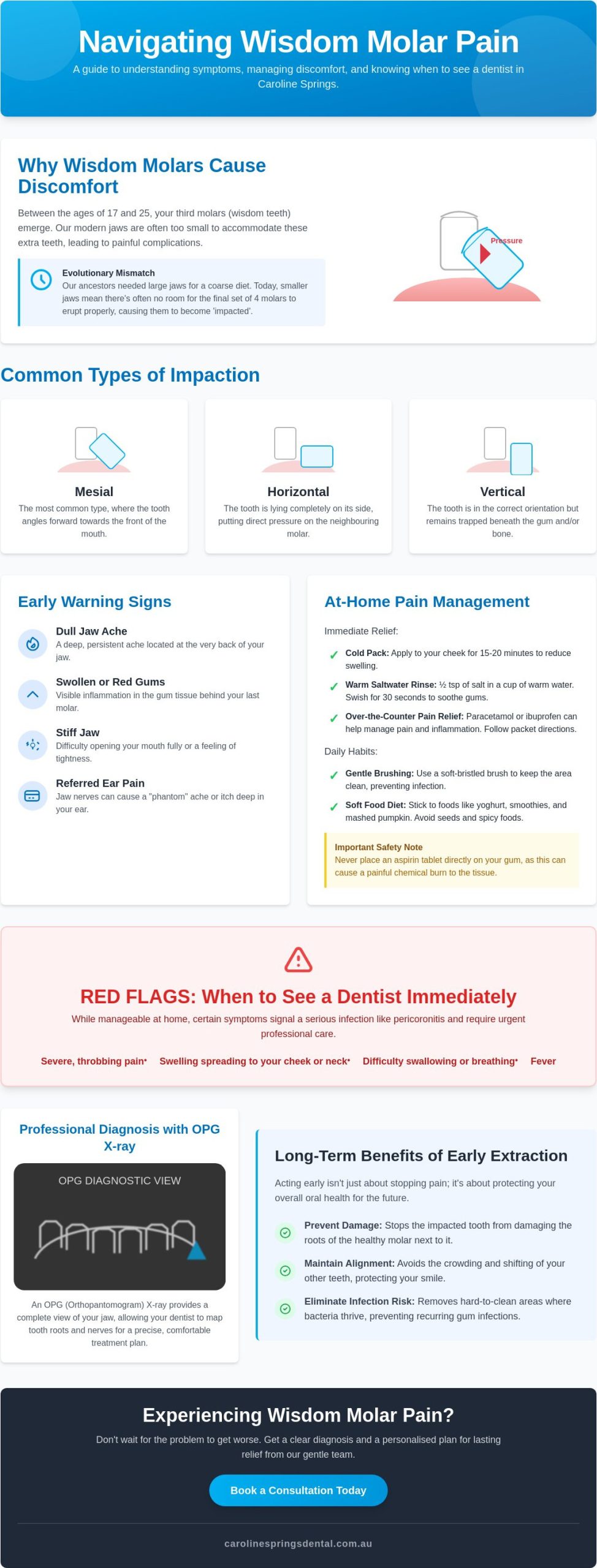
When a tooth cannot erupt into its proper position, it is classified based on the direction it’s growing. A “mesial” impaction is the most common, where the tooth angles forward toward the front of your mouth. “Horizontal” impactions are more stubborn, as the tooth lies completely on its side. In “vertical” cases, the tooth is upright but remains trapped beneath the gum line or bone.
A stuck tooth doesn’t just sit still; it puts constant, steady pressure on your second molar. This can lead to root damage or crowding of your other teeth. Additionally, if the tooth only partially breaks through the surface, it creates a small flap of gum tissue. This area is incredibly difficult to clean, making it a magnet for food particles and bacteria. If this leads to recurring infections, a professional wisdom tooth extraction is often the most reliable way to protect your long-term oral health.
Signs Your Third Molars are Starting to Move
Your body is excellent at sending signals when something is changing in your jaw. You don’t always need to see the tooth to know it’s moving. Common indicators include:
- A dull, heavy ache located deep in the back of the jaw.
- Visible redness or slight swelling in the gum tissue behind your last visible molar.
- Difficulty opening your mouth fully or a stiff sensation in the jaw joint.
You might also experience a “phantom earache.” Because the nerves in your lower jaw are so closely connected to your ear canal, wisdom molar pain can often feel like a deep ear itch or ache. If you notice these signs, it’s a good time to have a gentle chat with your dentist to see how those molars are progressing.
How to Manage Wisdom Molar Pain at Home: A Step-by-Step Guide
Managing wisdom molar pain requires a consistent routine to keep inflammation down and prevent bacteria from building up. Start your day by gently brushing the area with a soft-bristled toothbrush. Even if the tissue feels tender, keeping it clean is vital to prevent food debris from becoming trapped under the gum flap. Neglecting hygiene can lead to further irritation or localized infection, making the discomfort much harder to manage.
For visible jaw swelling, apply a cold pack to the outside of your cheek for 15 to 20 minutes at a time. This constricts blood vessels and numbs the area. If your jaw feels stiff or you are struggling to open your mouth, a warm compress can help relax the muscles. During this time, adjust your diet to include only soft foods like yoghurt, mashed pumpkin, or smoothies. Avoid small seeds, popcorn, or spicy seasonings, as these can easily lodge in the sensitive gaps around the emerging tooth.
Natural Rinses and Soothing Techniques
A warm saltwater rinse is one of the most effective ways to soothe oral tissues. The ideal ratio is half a teaspoon of salt dissolved in a cup of warm water. Swish this solution gently around the back of your mouth for 30 seconds before spitting. For more targeted relief, clove oil acts as a natural numbing agent due to its eugenol content. Apply a tiny amount to a cotton bud and dab it directly onto the sore gum. You might also try gentle acupressure by massaging the fleshy webbing between your thumb and index finger, which some find helps alleviate referred jaw tension.
Safe Use of Over-the-Counter Relief
When home remedies aren’t enough, visit your local chemist to discuss over-the-counter options. Paracetamol and ibuprofen are common choices in Australia for managing dental inflammation and pain. It is vital to follow the dosage instructions on the packaging and never place an aspirin tablet directly against your gums, as this can cause a chemical burn. While these medications provide temporary comfort, understanding the clinical reasons for Wisdom tooth removal can help you decide when it’s time to move beyond home care. Adult-strength numbing gels are also available to provide a protective barrier and dull the sharpest sensations.
Optimising Your Sleep Position
Discomfort often feels worse at night because lying flat increases blood flow to the head. Elevating your head with an extra pillow can reduce this pressure and lessen that rhythmic, throbbing sensation. Try to avoid sleeping on the side where the pain is most acute to prevent putting extra weight on the jaw joint. If you find your anxiety rising as bedtime approaches, a calm routine can help. Many patients feel much more at ease once they’ve had a gentle consultation to understand exactly what is happening with their teeth.
Recognising Red Flags: When Wisdom Molar Pain is an Emergency
While we have explored ways to manage mild discomfort at home, it is vital to know when your wisdom molar pain has crossed the line from a nuisance to a serious health risk. Dental issues rarely resolve themselves without professional intervention. Ignoring specific red flag symptoms can lead to complications that affect your jaw, your surrounding teeth, and even your general wellbeing. Understanding these signals helps you act before a small ache becomes a major crisis.
One of the most common complications is pericoronitis. This occurs when the operculum, the flap of gum tissue partially covering an emerging tooth, becomes a trap for food and bacteria. Because this area is nearly impossible to clean with a standard toothbrush, the tissue can quickly become infected. You might notice a persistent, foul taste in your mouth or visible oozing from the gums. These are clear indicators that bacteria are active and require clinical attention to prevent the infection from spreading deeper into the jaw.
Your body also uses systemic signals to tell you an infection is serious. If your wisdom molar pain is accompanied by a fever, chills, or a general sense of being unwell, your immune system is likely struggling to contain a dental infection. Watch for visible swelling that extends beyond the gum line. If your cheek looks puffy or you notice redness moving down toward your neck, the infection may be entering your soft tissues. This is a situation that requires immediate assessment to protect your health.
Understanding Pericoronitis and Abscesses
Bacteria thrive in the warm, dark pocket under the gum flap. If this local inflammation is not addressed, it can progress into a dental abscess. This is a collection of pus that can cause significant damage to the jawbone and the roots of neighbouring teeth. Some patients hope that a course of antibiotics from a GP will be a permanent solution. While medication can settle the immediate flare-up, it is often just a temporary fix. Until the physical source of the infection is managed by a dentist, the problem is likely to return, often more severely than before.
When to Call Caroline Springs Dental Clinic Immediately
Certain symptoms are considered critical emergencies. If you experience lockjaw, which is a restricted ability to open your mouth, or if you find it difficult to swallow or breathe, you must seek help right away. These signs suggest that swelling is beginning to impact your airway or the muscles used for jaw movement. We understand how frightening these experiences can be, and we are here to support you with a calm, professional approach.
Our team prioritises dental emergencies to ensure our local community members receive prompt relief. When you call Caroline Springs Dental Clinic, please tell the receptionist exactly what you are experiencing. Mention if you have a fever, how long the swelling has been present, and the specific nature of your pain. This information allows us to prepare for your arrival and ensure you receive the most appropriate care the moment you walk through our doors.
Professional Diagnosis and Treatment Options in Caroline Springs
Walking into a dental clinic when you are already dealing with wisdom molar pain can feel overwhelming. We understand that. Our goal during your initial consultation is to provide clarity and lower your anxiety. We start with a gentle physical examination and a conversation about your symptoms. This isn’t just about the tooth; it’s about how the discomfort affects your daily life and your ability to sleep or chew comfortably.
A key part of this process involves looking at your orthodontic history. If you’ve spent years perfecting your smile with braces or aligners, we want to ensure that emerging third molars don’t cause new crowding or shift your teeth out of alignment. We then create a personalised treatment plan that respects your unique jaw structure and long-term health goals. This tailored approach ensures that any intervention is necessary and beneficial for your specific situation.
Digital Imaging and Nerve Mapping
We can’t see everything with a visual exam alone. To get the full picture, we use OPG (panoramic) X-rays. This technology allows us to map exactly where the tooth roots are located in relation to your mandibular nerve. It’s a vital safety step. Using modern, low-radiation digital imaging ensures your safety while giving us the high-resolution detail needed to explain your situation clearly. You’ll be able to see exactly what we see on the screen, which helps you feel like a partner in your own dental care.
Non-Surgical Management for Minor Issues
Not every case of wisdom molar pain leads straight to an extraction. If the tooth is erupting normally but the surrounding gums are simply irritated, we might suggest non-surgical management. This can include a professional deep cleaning under the gum flap to clear out stubborn bacteria. We may also provide prescription-strength mouthwashes and specific hygiene instructions to settle the inflammation. In “wait and see” cases, we monitor the tooth’s progress over several months to see if it will eventually find its place without intervention.
If you’re tired of the constant throb and want a clear answer from a team that listens, we’re ready to support you. You can book your wisdom tooth consultation online today to find the relief you’ve been looking for.
Wisdom Tooth Extraction: Is It Always Necessary?
Deciding whether to proceed with a wisdom tooth extraction is a significant choice for many of our patients. While home remedies can soothe temporary wisdom molar pain, we must look at the long-term health of your entire mouth. For some, monitoring the teeth is a safe option if they are erupting straight and stay easy to clean. For others, early intervention is the best way to prevent the roots from becoming too firmly anchored in the jawbone, which makes later removal more complex.
Proactive removal isn’t just about stopping current discomfort. It’s about protecting your other teeth. Impacted molars often lean against their neighbours, creating tiny gaps where decay can start unnoticed. They can also lead to the development of fluid-filled cysts that may weaken the jaw. By addressing the issue early, you avoid the risk of jaw crowding and ensure your previous orthodontic work stays exactly as it should be. It is a preventative step that saves you from more invasive treatments in the future.
Taking a proactive approach to maintenance prevents minor issues from becoming major failures, a principle that applies whether you are managing your dental health or looking for expert infrastructure support from Streamline Drains & Pipelines (NSW).
The Extraction Process: Comfort and Care
We know that the idea of a dental procedure can be daunting. That’s why we focus on a gentle, patient-centred approach to lower your anxiety. We use effective local anaesthesia to ensure the area is completely numb, so you don’t feel pain during the procedure. Our team is particularly experienced in supporting nervous patients; we’ll talk you through each step at a pace that feels right for you. You are always in control of your appointment.
A standard extraction for a fully erupted tooth can often be completed in just a few minutes. A more complex case, where the tooth is still beneath the gum or bone, may take slightly longer, typically between 20 and 45 minutes. Regardless of the complexity, our priority is your comfort and ensuring you feel relaxed from the moment you sit in the chair until you’re ready to head home to rest.
Essential Aftercare for a Smooth Recovery
Your recovery starts the moment the procedure is over. The first 24 hours are the most important for ensuring a healthy healing process. We call these the “Golden Rules”: avoid using straws and don’t smoke. Both of these actions create suction in the mouth that can dislodge the blood clot, leading to a painful condition known as dry socket. Stick to soft, cool foods and keep your activity levels low to prevent unnecessary bleeding.
Living in Melbourne means our weather can be unpredictable. If it’s a particularly warm day, stay indoors with the air conditioning on and keep up your fluids to help manage any post-operative swelling. Using a cold pack on your cheek for short intervals during the first day is also very effective. For a detailed roadmap on what to expect as you heal, you can read our full guide on wisdom teeth removal recovery. We’re always here to help you move past wisdom molar pain and back to your healthy, active life.
Taking Control of Your Dental Comfort
Managing wisdom molar pain doesn’t have to be a journey you take alone. While salt water rinses and careful hygiene provide important temporary relief, a proactive assessment is the only way to ensure your smile remains healthy and aligned for the future. By identifying impaction early and using state-of-the-art digital X-ray technology to map your jaw, you can avoid the risks of overcrowding or persistent infection. Understanding the difference between normal eruption and a red-flag emergency gives you the confidence to act when it matters most.
We’ve been serving the Caroline Springs community for years, and our team is dedicated to providing gentle, family-focused restorative care that puts your comfort first. You don’t need to live with the anxiety of a throbbing jaw or wait for a minor ache to become a serious dental crisis. Whether you need a simple monitoring plan or a more permanent solution, we’re here to guide you with transparency and clinical expertise. Book your wisdom tooth assessment at Caroline Springs Dental Clinic today to regain your peace of mind. We look forward to helping you feel your best again.
Frequently Asked Questions
How long does wisdom molar pain typically last?
Wisdom molar pain often occurs in cycles that last about a week as the tooth attempts to break through the gum. While the initial soreness may subside as the tooth settles, it typically returns every few months until the tooth is fully erupted or removed. If the pain is persistent or throbbing for more than a few days, it usually indicates that the tooth is impacted or there is a localized infection that needs professional attention.
Can I ignore wisdom tooth pain if it goes away and comes back?
Ignoring pain that disappears and reappears is risky because the underlying cause remains unaddressed. This cycle often points to a partially erupted tooth that is trapping bacteria or putting pressure on your other molars. While you might feel temporary relief, the problem can worsen over time. This can lead to more complex issues like cysts or damage to the neighbouring tooth’s roots.
What is the best over-the-counter painkiller for toothaches in Australia?
Most Australians find that non-prescription anti-inflammatories like ibuprofen or paracetamol provide the most effective relief for dental discomfort. Ibuprofen is particularly helpful for reducing the swelling associated with emerging teeth. You should always speak with your local pharmacist to ensure these options are safe for you and to confirm the correct dosage for your specific needs.
Will my wisdom teeth definitely make my other teeth crooked?
Not everyone will experience shifting teeth, but many people find their smile becomes crowded as third molars push for space. If your jaw is already quite small, the pressure from these large teeth can cause your front teeth to overlap or rotate. A dental assessment with digital imaging is the only way to determine if your specific jaw structure can accommodate the extra teeth without affecting your alignment.
How do I know if my wisdom tooth is infected or just growing?
Normal growth usually feels like a dull pressure or a slight ache in the jaw. In contrast, an infection often presents with sharper pain, visible redness, and a foul taste or smell near the back of the mouth. If you notice significant swelling that makes it hard to open your mouth or if you develop a fever, these are clear signs that the area is infected rather than just growing.
Is wisdom tooth removal covered by Medicare or private health insurance?
Medicare generally does not cover dental extractions unless they are performed in a hospital for acute medical reasons. However, if you have private health insurance with “extras” cover, your policy will often pay for a portion of the cost, typically between 50% and 80%. It is important to check your specific plan for any 12-month waiting periods that usually apply to major dental procedures.
Can salt water really help with wisdom tooth pain?
A warm salt water rinse is a highly effective natural disinfectant for managing minor oral irritations. The saline solution helps to draw out fluid from inflamed tissues and kills some of the bacteria that thrive under gum flaps. While it won’t fix an impacted tooth, it is an excellent way to keep the area clean and provide temporary relief from the stinging sensation of tender gums.
What can I eat when my back molars are hurting?
Stick to a soft-food diet that requires minimal chewing to avoid irritating the sensitive area at the back of your jaw. Excellent options include lukewarm soups, smoothies, scrambled eggs, and mashed vegetables like pumpkin or potato. You should avoid crunchy, spicy, or acidic foods, as well as anything with small seeds that could easily become trapped in the gaps around the sore tooth.