


What if a single cracked tooth didn’t have to mean the end of your natural smile? For many of our patients at Caroline Springs Dental Clinic, discovering a damaged tooth brings up a wave of questions, most notably: when is a dental crown necessary? It’s natural to feel a bit of anxiety about dental procedures, especially if you’re worried about potential pain, the number of appointments required, or whether the final result will look like a real tooth. We understand those concerns and are here to show you that modern restorative care is designed with your comfort and confidence as the top priority.
In this guide, we’ll walk you through the entire dental crown process as it stands in 2026, taking you from that first consultation through to the final fitting. You will discover how advanced anaesthetics make the experience virtually painless and how we use high-quality materials to ensure your new crown blends perfectly with your smile. By the end of this article, you’ll have a clear, step-by-step understanding of the two-visit process, giving you the reassurance you need to move forward with peace of mind.
Key Takeaways
- Learn the specific clinical indicators for when is a dental crown necessary, such as protecting a tooth after root canal therapy or reinforcing a cracked molar.
- Discover how modern local anaesthetics and gentle clinical techniques ensure your preparation appointment is completely comfortable and stress-free.
- Understand the precision involved in custom-milling your crown at a specialised laboratory to achieve a perfect bite and a natural colour match.
- Gain practical advice on managing post-operative sensitivity and choosing the right foods to protect your new restoration during the first 24 hours.
- Explore how our Caroline Springs team integrates advanced technology with a warm, family-centred approach to put even the most nervous patients at ease.
Understanding Dental Crowns: Why You Might Need a Cap
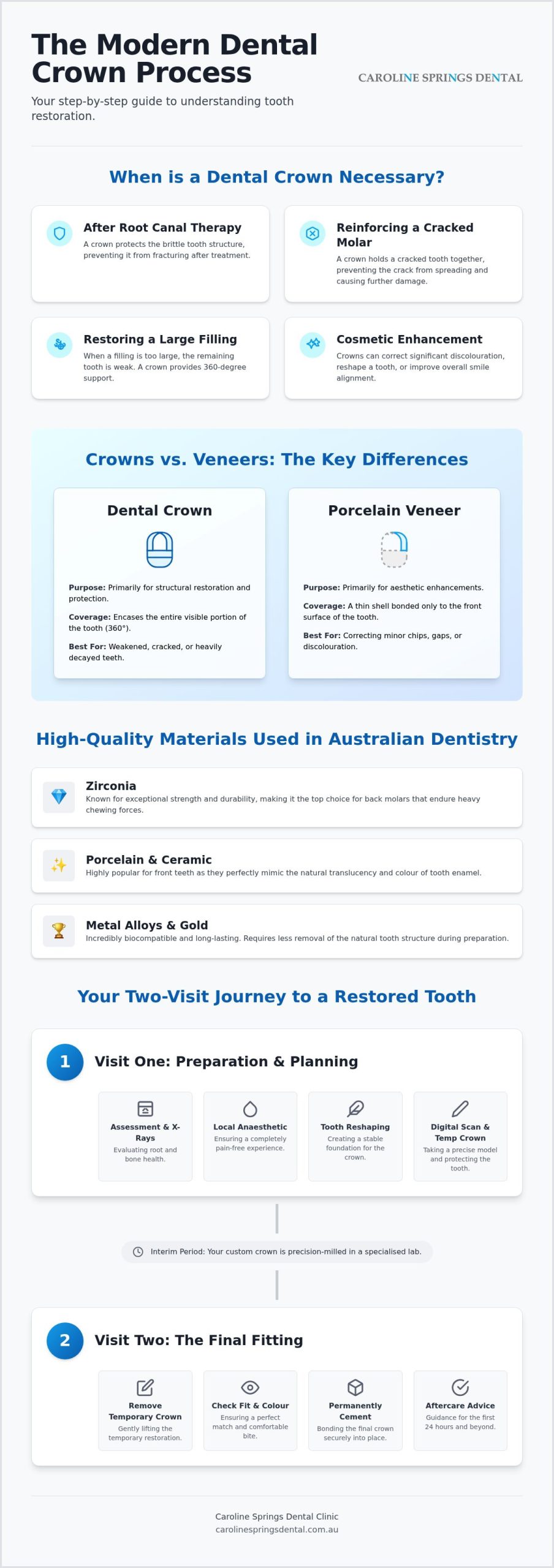
A dental crown is essentially a custom-fitted restoration that acts as a protective shield for a compromised tooth. If you have been researching what is a dental crown, you will find it is designed to encase the entire visible portion of your tooth right down to the gum line. At Caroline Springs Dental Clinic, we often describe it as a protective helmet that restores the tooth’s shape, size, and strength. Unlike a standard filling that sits within the tooth to patch a specific cavity, a crown provides 360-degree reinforcement. This makes it an ideal solution for teeth that have become too fragile to function safely on their own.
Many patients come to us asking: when is a dental crown necessary? Usually, our dentists recommend this treatment when a tooth lacks the structural integrity to withstand the daily pressures of biting and chewing. This might be due to a very large filling that has started to fail, a deep crack that threatens the root, or severe decay that has hollowed out the tooth. It is also the standard follow-up treatment after root canal treatment, as these teeth can become brittle and prone to fracturing without the added support of a cap. Beyond health, crowns are also used in cosmetic dentistry to correct significant discolouration or to reshape a tooth that doesn’t align with your smile.
Crowns vs. Veneers: What is the difference?
While both treatments improve your smile’s appearance, they serve different structural roles. Porcelain veneers are thin shells bonded only to the front surface of the tooth, primarily for aesthetic enhancements. In contrast, a crown covers the whole tooth structure. Our team at Caroline Springs Dental Clinic generally recommends a crown over a veneer when the tooth is broken or weakened, as the full coverage provides far superior durability and lifespan for teeth under heavy biting pressure.
Common materials used in Australian dentistry
Australian dental labs utilise several high-grade materials to ensure your restoration is both functional and beautiful. The choice typically depends on the tooth’s location and your specific needs:
- Porcelain and Ceramic: These are highly popular for front teeth because they mimic the natural translucency of enamel.
- Zirconia: Known for exceptional strength, this is often the first choice for back molars that handle heavy chewing forces.
- Metal Alloys and Gold: While less common for aesthetics, gold is incredibly biocompatible and preserves more of the natural tooth structure during preparation.
Determining when is a dental crown necessary requires a personalised assessment to see which material and approach will best protect your long-term oral health.
The Preparation Phase: Your First Appointment
Your journey to a restored smile begins with a thorough and gentle first visit. This appointment is all about precision and planning. We start with a clinical assessment and X-rays to evaluate the health of the tooth’s root and the surrounding bone. This step is crucial because it confirms the tooth is strong enough to support the restoration. Understanding dental crown procedure steps helps many of our patients feel more at ease before they even sit in the chair. If we find significant decay or risk of infection, we might discuss other treatments first, but usually, this visit moves straight into preparation.
We know that many people in the Western Suburbs feel a bit of trepidation about dental work. To ensure a completely pain-free experience, we administer a local anaesthetic to the area. Once you’re comfortable, our dentist begins reshaping the tooth. This involves removing a small amount of the outer enamel to create a stable, tapered foundation for the new cap. We take great care to preserve as much of your natural tooth as possible while ensuring the crown will have enough space to sit flush with your other teeth. If you are unsure whether your tooth can be saved, our team can help you understand dental crown and bridge restoration options during a personalised consultation.
Digital Scanning vs. Traditional Moulds
After the tooth is prepared, we need an exact model of your mouth. Traditionally, this involved biting into a tray filled with a thick, putty-like material. While effective, some patients find this uncomfortable. Many modern clinics now utilise 3D intraoral scanning. This technology uses a small wand to take thousands of tiny photos, creating a highly accurate digital map of your teeth in minutes. This digital approach is often faster and much more comfortable. We also use this stage to meticulously match the shade of your new crown to your surrounding natural teeth, ensuring the final result looks completely seamless.
The Role of the Temporary Crown
Because your permanent crown is custom-made in a specialised laboratory, it won’t be ready immediately. We place a temporary crown over your prepared tooth to protect it and maintain your bite alignment. This temporary cap is usually made of acrylic and held in place with temporary cement. It’s important to be gentle with it; avoid sticky or very hard foods that might pull it off. If it feels high when you bite or becomes loose, give us a call straight away. While it’s only a short-term fix, it plays a vital role in keeping you comfortable while your permanent restoration is being crafted. Knowing when is a dental crown necessary is the first step, but this preparation phase is where the real transformation begins.
Crafting and Fitting Your Custom Crown
Once your impressions or digital scans are complete, the focus shifts to the creation of your bespoke restoration. This isn’t a mass-produced item; it’s a piece of medical-grade art tailored specifically to your mouth. While some might wonder when is a dental crown necessary, the answer often lies in the desire to restore both function and a natural appearance to a damaged tooth. This stage of the process ensures your new tooth doesn’t just fill a gap, but performs exactly like the original.
The Laboratory Process
Your digital or physical models travel to a specialised dental laboratory. Here, skilled technicians use precision milling technology to carve the basic shape of your crown from a solid block of your chosen material. However, the real magic happens during the hand-finishing stage. Technicians apply layers of porcelain to mimic the unique translucency and light-reflecting properties of your natural enamel. This meticulous process is why quality custom work typically takes one to two weeks. Every crown must meet strict Australian dental standards for biocompatibility and strength before it returns to our clinic in Caroline Springs.
The Final Fitting Appointment
When your custom crown arrives, you’ll return for your second appointment. This visit is often the most exciting part of the journey. We start by gently removing the temporary cap and cleaning the prepared tooth to ensure a pristine surface. Before we apply any permanent cement, we enter the “Try-in” phase. This is your moment of truth. We place the crown on the tooth and hand you a mirror. We want you to be completely happy with the colour match and the shape before anything is made permanent.
While you check the aesthetics, our dentist checks the fit and your occlusion. This is a technical term for how your upper and lower teeth meet. If the bite feels “high” or slightly off, we make tiny adjustments right then and there. Once we are both satisfied, we use high-strength dental cement to bond the crown permanently. This creates a long-lasting, bacteria-proof seal around your natural tooth. We perform one last check to ensure the new tooth feels natural when you speak and eat. You’ll leave our clinic with the confidence that your smile is strong and seamless once again.
Recovery and Aftercare: Protecting Your Investment
Once the permanent bonding process at Caroline Springs Dental Clinic is finished, the focus shifts to ensuring your new restoration remains comfortable and secure for the long term. While the clinical decision regarding when is a dental crown necessary is made to save a compromised tooth, the daily care you provide at home determines how many years of service you’ll get from that restoration. Immediately following your appointment, it’s common to feel some mild sensitivity as the anaesthetic wears off. Your gums might also feel a little tender where the crown meets the gum line, but this usually settles within a day or two as the tissue adjusts to the new cap.
To ensure the high-strength cement reaches its full bonding potential, we recommend being mindful of your diet for the first 24 hours. It’s best to avoid very sticky foods like toffee or particularly hard snacks that could put undue pressure on the crown before the seal is fully matured. Beyond this initial window, your crown should function just like a natural tooth. Long-term success relies on diligent hygiene; brushing twice daily and flossing are non-negotiable. When flossing, pay extra attention to the margin where the crown meets the natural tooth, as this is the most common area for plaque to accumulate if neglected.
Managing Sensitivity and Discomfort
If you notice some lingering gum tenderness, a warm salt water rinse is a simple, effective way to soothe the area. For patients who find the tooth reacts to temperature changes in the first few days, using a sensitive toothpaste can provide significant relief. One vital thing to monitor is how your teeth meet. If the crown feels “high” or you notice a sharp point when you chew after the numbness has fully faded, please call us. A quick, painless adjustment to the crown’s surface at Caroline Springs Dental Clinic is often all that’s needed to ensure your bite is perfectly balanced.
How to make your crown last 15+ years
A high-quality crown can easily last 15 years or more if you avoid habits that put it at risk. This includes not using your teeth as tools to open packaging and avoiding chewing on ice or hard pens. For our patients in the Western Suburbs who grind their teeth at night, we often suggest a protective barrier. You can learn about our custom mouthguards to see how we protect restorative work from the physical stress of nocturnal grinding. Routine six-monthly check-ups are the final piece of the puzzle, allowing us to monitor the crown’s margins and ensure the underlying tooth stays healthy.
If you’re ready to ensure your dental health is on the right track, you can book your next check-up online with our friendly team today.
Restorative Care at Caroline Springs Dental Clinic
Choosing the right practice for your restorative work is just as vital as knowing when is a dental crown necessary. At Caroline Springs Dental Clinic, we’ve built our reputation on a foundation of gentle, family-centred care that prioritises your comfort alongside clinical excellence. We understand that for many of our neighbours in the Western Suburbs, a visit to the dentist can be met with a bit of trepidation. Our goal is to change that narrative. By combining advanced technology, such as digital intraoral scanners, with a warm and hospitality-focused environment, we ensure that your journey to a restored smile is both modern and deeply personal.
Our clinic is a convenient hub for residents of Deanside, Taylors Hill, and Fraser Rise. We believe that high-quality dental care should be accessible and stress-free for every member of the family. This commitment extends beyond the dental chair; we offer flexible payment options and seamless health fund integration to help local families manage their dental health. To learn more about maintaining a healthy smile through different care models, you can explore Private and NHS Dental Treatments for further insights into comprehensive oral health. You aren’t just another patient on a list here; you’re a member of our community, and we treat your smile with the same care we would give our own families.
Why Local Families Trust Us
Our team has extensive experience in restorative dentistry Caroline Springs, specialising in solutions that are both functional and beautiful. We believe in transparency. This means we take the time to sit down with you, review your X-rays together, and discuss the rationale behind our recommendations. If you’re wondering when is a dental crown necessary versus a simpler filling, we’ll show you the structural reasons why a crown might be the better long-term investment for your health. Whether you require a single restoration or wish to explore our full range of services, you can expect a partner who listens to your concerns and respects your goals.
Book Your Consultation Today
Reclaiming your confidence starts with a single, simple step. Our clinic is easy to find, located just a short distance from the beautiful Caroline Springs Lake, making it easy to fit your dental care into your daily routine. We’ve streamlined our processes to ensure that from the moment you walk through our doors, you feel cared for and respected. Don’t let a damaged tooth affect your quality of life or your self-esteem any longer. Our friendly team is ready to help you navigate your treatment options in a calm, supportive setting. You can book your appointment online or give us a call to start your journey toward a stronger, more radiant smile today.
Secure Your Smile for the Future
Restoring a damaged tooth is about more than just aesthetics; it’s about preserving your long-term oral health and bite function. We’ve explored how the two-visit process works and why modern materials like zirconia and porcelain are the preferred choices for durability and a lifelike finish. Understanding when is a dental crown necessary is simply the first step in a journey we take together. Whether you’re dealing with a crack, severe decay, or protecting a tooth after a root canal, our team’s here to guide you through every stage with a gentle touch.
At Caroline Springs Dental Clinic, we’re proud to serve our local community with restorative care that puts your comfort first. We use our expertise in porcelain and zirconia restorations to ensure your crown fits perfectly and looks completely natural. For your convenience, we have HICAPS available on-site for on-the-spot health fund claims, making the administrative side of your visit as smooth as the clinical one. You don’t have to live with dental discomfort or a smile you’re hesitant to show.
Book your dental crown consultation at Caroline Springs Dental Clinic and let us help you smile with confidence again. We look forward to welcoming you to our clinic soon.
Frequently Asked Questions
Does the dental crown procedure hurt?
The dental crown procedure is designed to be completely comfortable because we use local anaesthetic to numb the tooth and surrounding gums. You shouldn’t feel any pain during the reshaping or impression-taking stages, though you might notice some mild pressure. After the numbing wears off, some patients experience slight gum tenderness or temperature sensitivity, but this typically settles within a few days and is easily managed with standard over-the-counter relief.
How many appointments are needed for a dental crown?
Most patients require two separate appointments spaced roughly one to two weeks apart. Your first visit is dedicated to preparing the tooth and taking digital or traditional impressions, after which we place a temporary cap. The second visit is when we fit and permanently bond your custom-made crown. This gap allows the dental laboratory technicians enough time to precision-mill and hand-finish your restoration to the highest Australian standards.
How long do dental crowns usually last?
A well-maintained dental crown typically lasts between 10 and 15 years, though many of our patients enjoy theirs for much longer. The lifespan of your restoration depends heavily on your daily oral hygiene habits and regular professional cleans. Brushing twice a day and flossing around the crown’s margin is essential to prevent decay from forming underneath the cap. Avoiding hard objects, like ice or pens, also prevents the porcelain from chipping.
Can a crown be placed on a tooth with a root canal?
Yes, placing a crown after root canal therapy is the standard clinical recommendation to protect the tooth from fracturing. Because a root canal involves removing the tooth’s internal pulp, the remaining structure can become brittle over time. A crown provides the 360-degree reinforcement needed to keep the tooth functional. This is a primary example of when is a dental crown necessary to prevent the eventual loss of the tooth.
What happens if a dental crown falls off?
If your crown comes loose, you should keep it safe and contact our clinic immediately to have it professionally rebonded. Please do not attempt to use household glues to fix it yourself, as these can be toxic and may damage your natural tooth. If the crown and the underlying tooth are both still in good condition, we can often clean the surfaces and cement the original restoration back into place quite easily.
Will my dental crown look like a natural tooth?
Modern dental crowns are engineered to be virtually indistinguishable from your natural teeth. We use high-quality porcelain and zirconia materials that mimic the translucency and light-reflecting qualities of real enamel. During the preparation phase, we meticulously match the shade of the crown to your surrounding teeth. This ensures that once the permanent crown is fitted, it blends seamlessly into your smile, even in high-visibility areas at the front of your mouth.
How much does a dental crown cost in Melbourne?
In Melbourne, the typical price for a dental crown in 2026 ranges from A$1,800 to A$2,500 per tooth. The final cost depends on several factors, including the material chosen and the complexity of the preparation required. Most private health insurance policies with “extras” cover will provide a rebate for crowns under their Major Dental category, though it’s important to check if you’ve served your standard 12-month waiting period first.
Is there an alternative to getting a dental crown?
The most common alternatives are large composite fillings or dental onlays, though these may not provide enough support for a heavily damaged tooth. While a filling can repair a cavity, it doesn’t wrap around the tooth to protect it from splitting. Determining when is a dental crown necessary involves weighing these options; if the tooth is too weak for a filling but doesn’t yet require extraction, a crown is usually the most reliable way to save it.