


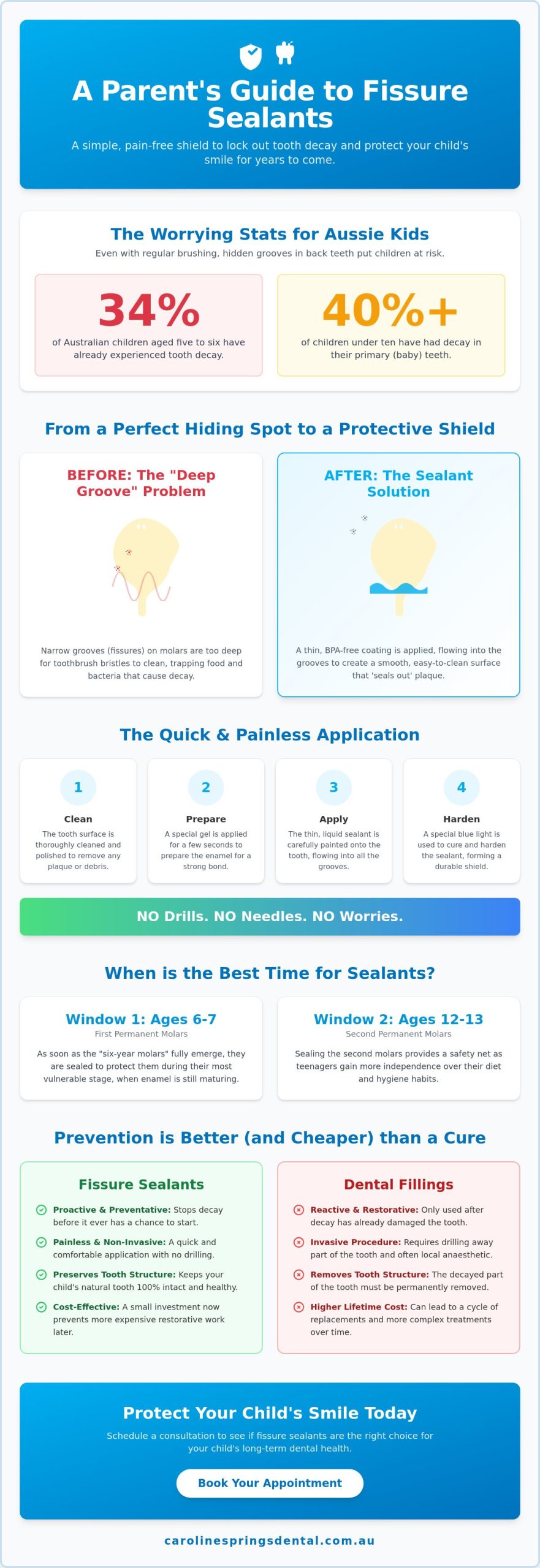
Did you know that 34% of Australian children aged five to six have already experienced tooth decay? It’s a worrying statistic for any parent, especially when you consider that over 40% of kids under ten have had decay in their primary teeth. You want to protect those growing smiles, but the thought of your child needing a filling can be stressful for everyone involved. Thankfully, fissure sealants for kids offer a simple, non-invasive way to lock out bacteria and keep those back teeth healthy for years to come.
We understand that dental jargon can be confusing and the worry about long-term costs is real. You’re looking for a way to ensure your child’s dental visits are positive and pain-free while keeping your family budget on track. This guide will walk you through exactly how sealants provide a protective shield for your child’s teeth, saving them from future decay and you from expensive restorative work. We’ll explore the simple application process, the long-term benefits, and how the Child Dental Benefits Schedule can make preventative care more accessible for your family.
Key Takeaways
- Discover how fissure sealants for kids create a protective shield over deep grooves that toothbrushes often can’t reach.
- Identify the critical age windows when your child’s adult molars are most at risk and why timing is everything for prevention.
- Get a step-by-step look at the gentle application process, which requires no drilling and no local anaesthetic.
- Compare the long-term benefits of proactive sealing versus the cycle of restorative fillings to protect both your child’s smile and your budget.
- Learn how a family-centred approach and modern techniques make preventative care a positive, stress-free experience for your little ones.
What are Fissure Sealants for Kids and How Do They Work?
When we talk about fissure sealants for kids, we are describing a clever, preventative treatment designed to act as a raincoat for your child’s teeth. In simple terms, a sealant is a thin, protective plastic coating that our team applies to the chewing surfaces of the back teeth, specifically the molars and premolars. Because these teeth do the heavy lifting when it comes to grinding up food, they’re often the first places where decay starts to take hold. By understanding what dental sealants are, you can see how they provide a smooth, easy to clean surface that keeps bacteria at bay.
The primary reason we recommend this treatment is the “Deep Groove” problem. If you look closely at a molar, you’ll see tiny lines and pits across the surface. These are known as fissures. In many children, these grooves are so narrow and deep that a single toothbrush bristle is actually too thick to reach the bottom. This creates a perfect hiding spot for microscopic food particles and acid-producing bacteria. Even the most diligent brushers can’t always clear these areas, which is why sealants are such a game-changer for long-term health.
Modern Australian dentistry prioritises safety and comfort, so you’ll be pleased to know that the materials we use are high-quality and typically BPA-free. The sealant starts as a liquid that flows into every nook and cranny of the tooth’s surface. Once we use a special curing light to harden it, it forms a durable, plastic barrier. This shield effectively “seals out” the elements that cause cavities, ensuring that plaque has nowhere to hide.
Visualising the Fissures: Pits and Grooves
It helps to think of your child’s molars as a landscape of miniature mountains and valleys. The fissures are the narrow canyons between the peaks. While the “peaks” of the teeth are easily cleaned by eating crunchy foods or brushing, the “canyons” collect debris. Research suggests that around 80% of decay in permanent teeth occurs in these specific pits and grooves. By filling these valleys with a smooth sealant, we transform a complex, hard to reach surface into one that is flat and simple for your child to maintain with their morning and nightly brush.
The Role of Sealants in Preventative Care
We view sealants as a vital partner to our broader children’s dentistry services. It’s important to distinguish between preventative and restorative care. A filling is restorative; it’s what we use to fix a tooth after a cavity has already caused damage. A sealant is purely preventative. It’s about stopping the damage before it ever begins. For our Caroline Springs families, we often suggest sealants during routine check-ups as a proactive way to avoid the need for more invasive work later in life. It’s a simple step that keeps your child’s natural tooth structure intact and healthy.
The Best Age for Sealants: When is the Ideal Window?
Timing is everything when it comes to preventative dental care. While we can apply fissure sealants for kids at various stages, there is a specific “window of opportunity” that offers the most significant protection for your child’s long-term health. This window opens the moment a permanent molar fully erupts through the gum line, usually around age six and again around age twelve. Acting during this period ensures the tooth is protected before decay has any chance to start.
The first permanent molars, often called the “six-year molars,” are our primary targets. These teeth are the workhorses of the mouth, but because they appear so early, they are often mistaken for baby teeth. This leads to them being overlooked during brushing, making them highly susceptible to early decay. Following the American Dental Association guidelines, we recommend sealing these teeth as soon as the chewing surface is visible and free from gum tissue.
The second window occurs as children enter their early teens, typically around age twelve. These second molars arrive just as kids are gaining more independence with their diet and hygiene, which can sometimes lead to a dip in oral care consistency. By sealing these teeth early, we provide a safety net during those busy high school years when sugary snacks and drinks might become more common in their daily routine.
Why is speed so vital? When a tooth first erupts, the enamel is not yet fully mineralised. It is “softer” and more vulnerable to acid attack from plaque. This vulnerability window is the ideal time to apply a sealant. While teenagers and even some adults can benefit from sealants if their fissures are deep and decay-free, the greatest impact is achieved during these specific childhood milestones. It’s about protecting the tooth in its most pristine state.
Milestones for Melbourne Parents
For families in our local community, these dental milestones often coincide with major school transitions. We usually see the first molars appearing when children are in Prep or Year 1. The second set often arrives just as they are preparing for the big move to Year 7. During a routine visit to a children’s dentist in Caroline Springs, we specifically check for these erupting teeth. You might notice your child complaining of sore gums at the back of their mouth or see the white tips of new teeth peeking through. These are your cues to consider a preventative assessment.
Is Your Child a Candidate? Assessment Criteria
Not every child needs sealants on every molar. At our clinic, we take a personalised approach to determine suitability. We look at the physical anatomy of the tooth; some children naturally have shallower grooves that are easier to clean with standard brushing. We also consider your child’s history of cavities and their current oral hygiene habits. If you are curious about whether your little one could benefit from this extra layer of protection, you can always book a consultation with our friendly team to discuss a tailored preventative plan.
The Step-by-Step Procedure: A Painless, No-Drill Experience
One of the most common worries for parents is whether their child will feel pain during treatment. When it comes to applying fissure sealants for kids, the experience is remarkably gentle and entirely non-invasive. Unlike restorative work, there is no drilling and no removal of tooth enamel. It is a straightforward process that helps your child feel comfortable and confident in the dental chair while providing a significant health benefit.
The procedure is methodical and follows a clear set of steps to ensure the best possible result:
- Preparation: The tooth is given a professional clean to remove any lingering plaque or food debris from the deep grooves.
- Conditioning: A mild solution is applied to the chewing surface to create a microscopic texture. This helps the sealant bond securely to the enamel.
- Application: The liquid sealant is carefully painted into the fissures using a tiny, specialised brush, flowing into every pit and valley.
- Setting: A specialised blue curing light is used to harden the material, turning it into a solid, durable shield in just a few seconds.
Why Kids Love the “No-Numbing” Approach
Parents are often relieved to learn that local anaesthetic is never required for this procedure. Because the treatment is superficial and doesn’t involve needles, it is an excellent way to build a positive association with dental visits. At Caroline Springs Dental Clinic, we make the process engaging by showing children how the “magic light” works. Most kids find it fascinating and appreciate that there is no “numb” feeling or “pins and needles” afterwards. Since the process is so quick, it is perfect for younger children with shorter attention spans. If you’re just beginning your child’s dental journey, our guide on preparing for your toddler’s first dental checkup offers practical tips to help make every visit a positive experience from the very start.
Aftercare and Immediate Next Steps
There is no waiting period once the treatment is finished. Because the curing light sets the material instantly, your child can eat and drink as soon as they leave the clinic. They might notice a slightly different feeling on the surface of the tooth for the first hour, but this sensation disappears almost immediately as the thin layer settles. To keep the protection strong, simply continue with regular brushing and flossing. Our team will monitor the integrity of the sealants during every six-monthly check-up to ensure they continue to provide a solid barrier against decay.
Fissure Sealants vs. Fillings: Comparing Costs and Outcomes
Choosing between a proactive or reactive approach to dental health can significantly impact your child’s future well-being. While both fissure sealants for kids and composite fillings aim to manage decay, they represent two very different philosophies of care. A sealant is a preventative shield that preserves the entire natural tooth structure. A filling, by contrast, is a restorative fix that requires the removal of decayed enamel. By opting for sealants, you are choosing to stop a problem before it starts, which is always the gentlest path for a young patient.
One of the most compelling reasons to choose sealants is to break the “filling cycle.” When a child receives their first filling, that tooth is permanently altered. Over time, fillings can wear down, leak, or develop secondary decay, often requiring larger restorations, crowns, or even more complex work as the child reaches adulthood. Because sealants can reduce molar decay by up to 80%, they effectively delay or entirely prevent that first drill, keeping the tooth’s original strength intact for as long as possible.
From a financial perspective, sealants are a sensible investment for any family. The cost of a preventative sealant is typically a small fraction of what you would pay for a multi-surface composite filling. When you consider that a well-maintained sealant can last between five and ten years, the return on investment is clear. It is far more affordable to maintain a healthy tooth than it is to repair a damaged one repeatedly over a lifetime.
Protecting the Natural Tooth Structure
The beauty of a sealant lies in its non-invasive nature. Because the material sits on top of the tooth, we don’t need to remove any healthy enamel. This preservation is vital for preventing the progression toward root canal treatment later in life. Beyond the physical benefits, there is a massive psychological win for your child. Avoiding the needles and drills associated with fillings helps foster a positive relationship with the dentist. Your child learns that coming to see us is about protection and comfort, not just “fixing things that hurt.”
Health Funds and Payment Options
Most Australian private health funds recognise the value of prevention and cover sealants under “General” or “Preventative” dental categories. For many families, this means little to no out-of-pocket expense. Additionally, the Australian Government’s Child Dental Benefits Schedule (CDBS) provides up to $1,132 per eligible child over two calendar years for basic services, including sealants. We encourage you to check our payment options and health funds page to see how you can best utilise these benefits. If you’re ready to secure your child’s smile, you can book an appointment online today to discuss a preventative plan tailored to their needs.
Why Choose Caroline Springs Dental Clinic for Your Child’s Sealants?
Choosing the right dental home for your family is about more than just finding a clinic; it’s about finding a partner in your child’s long-term health journey. When it comes to fissure sealants for kids, our team combines clinical precision with a warm, community-focused hospitality that lowers the anxiety often associated with dental visits. We don’t just apply a protective coating; we take the time to make sure your little one feels like a “dental superstar” from the moment they walk through our doors.
Our approach at Caroline Springs Dental Clinic is built on trust and gentle professionalism. We utilise state-of-the-art equipment and high-quality, durable materials to ensure every sealant is applied with the utmost care. We realise that for many families in Caroline Springs, Taylors Hill, and Deanside, convenience is just as important as clinical excellence. Our modern clinic is designed to be a stress-free environment where kids feel safe and parents feel respected and heard.
By choosing a local guide for your child’s dental care, you’re ensuring they receive personalised attention that grows with them. We don’t believe in a one-size-fits-all solution. Instead, we look at the unique anatomy of your child’s teeth and their specific health history to provide recommendations that truly make sense for their future.
Our Local Community Commitment
We’ve spent years serving the Western Suburbs, and we take our role as a trusted neighbour seriously. Our commitment goes beyond a single appointment. We integrate preventative treatments into a comprehensive oral health plan that evolves as your child reaches new milestones. We invite you to bring your family in to meet our friendly team and see our kid-friendly environment firsthand. You’ll find that our rhythm is calm and methodical, ensuring that no child ever feels rushed or overwhelmed during their care at Caroline Springs Dental Clinic.
Booking Your Child’s Preventative Assessment
We know that life as a parent in Melbourne’s west is busy. That’s why we’ve organised our process to be as efficient as possible. During your first consultation, we’ll perform a gentle assessment of your child’s molars, discuss the depth of their fissures, and answer any questions you have about the process. There are no surprises and no pressure, just clear communication from a team that genuinely cares. It’s a simple, proactive step that can save your child from future discomfort. You can book an appointment today to protect your child’s smile and enjoy the peace of mind that comes with professional preventative care.
Securing a Healthy Smile for Your Child’s Future
Protecting your child’s adult teeth doesn’t have to be a source of stress or high costs. A simple, no-drill barrier can stop decay before it ever starts, keeping those permanent molars in their most pristine condition. By choosing fissure sealants for kids, you’re investing in a future of comfortable dental visits and helping your child avoid the cycle of restorative fillings later in life. It’s one of the most effective ways to preserve natural tooth structure while keeping your family budget on track through smart, preventative care.
Our family-friendly clinic is proud to serve the Western Suburbs with a focus on gentle, empathetic care. We specialise in making dentistry a positive, educational experience for our youngest patients. If you’re ready to explore these pain-free preventative options, our experienced team is here to guide you through every step of the journey. Book Your Child’s Dental Assessment in Caroline Springs to take the first step toward a lifetime of healthy, confident smiles. We look forward to welcoming your family and ensuring your little ones feel like dental superstars at every visit.
Frequently Asked Questions
Do fissure sealants hurt?
No, the process is completely pain-free and non-invasive. Since there is no removal of tooth structure, we don’t need to use needles or local anaesthetic. Most children find the experience quite easy and even a bit interesting as they watch the blue curing light harden the coating in seconds.
How long do fissure sealants last on a child’s teeth?
Fissure sealants for kids typically last between five and ten years with proper care. While they are quite durable, they can wear down over time due to the heavy pressure of chewing. We check the condition of each sealant during your child’s regular six-monthly check-ups to ensure the barrier remains completely intact.
Are fissure sealants safe and BPA-free?
Yes, modern sealants are exceptionally safe and are made from medical-grade dental resins. Most of the materials used in Australian clinics today are BPA-free, providing a healthy way to protect your child’s teeth without concern. We prioritise using high-quality, biocompatible materials that are gentle on your child’s growing body.
What happens if a fissure sealant falls off?
If a sealant chips or falls off, the tooth simply returns to its original state with the deep grooves exposed. It isn’t a dental emergency, but it does mean the protective shield is gone. We can easily re-apply the sealant during their next visit to ensure the tooth stays protected from bacteria and plaque.
Can my child still get cavities if they have sealants?
Your child can still get cavities on other parts of the tooth, such as between the teeth where the sealant isn’t applied. While sealants are incredibly effective at protecting the chewing surfaces, they don’t replace the need for daily flossing and brushing with fluoride toothpaste to protect the rest of the enamel.
Does Medicare or the CDBS cover the cost of sealants?
Yes, the Child Dental Benefits Schedule (CDBS) covers the cost of fissure sealants for eligible children. For the 2025-2026 period, the benefit cap is $1,132 per child over two consecutive years. This government initiative makes preventative treatments much more accessible for families receiving certain payments like Family Tax Benefit Part A.
Can sealants be placed over existing decay?
We generally don’t place sealants over established cavities, as this could trap decay inside the tooth. Sealants are designed for healthy teeth or those showing the very earliest signs of “white spot” lesions. If a cavity has already progressed, we would typically recommend a composite filling to restore the tooth’s health.
Is there any special diet my child needs to follow after getting sealants?
There is no special diet required after the procedure, and your child can eat and drink immediately. However, it’s always a good idea to avoid very sticky lollies like toffee or hard caramels. These can occasionally pull at the sealant material, though this is rare with modern, high-strength bonding techniques used in our clinic. For families who are just beginning their child’s dental journey, our comprehensive guide on what to expect at a dental checkup for toddlers can help you feel fully prepared for every stage of your child’s oral health care.