


The best cosmetic dental treatment isn’t always the one that looks the most dramatic on day one. When weighing up Invisalign vs veneers, many people assume veneers are the shortcut to a perfect smile, but covering up misaligned teeth without addressing the underlying structure can create more problems down the track.
You’re not alone if you’ve been standing in front of the mirror wondering whether to straighten your teeth properly or simply transform their appearance with a porcelain finish. It’s one of the most common questions patients ask, and the honest answer is that it genuinely depends on what your smile needs most.
In this guide, we’ll walk you through the key differences between Invisalign and porcelain veneers, including how each treatment works, who they’re best suited for, what to expect in terms of your natural tooth structure, and how to think about long-term value. Whether you’re in Caroline Springs, Taylors Hill, Burnside, or the surrounding suburbs, this is your starting point for making a confident, well-informed decision about your smile.
Key Takeaways
- When weighing up Invisalign vs veneers, the right choice depends on the underlying condition of your teeth — not just the cosmetic result you’re after.
- Invisalign physically moves teeth into alignment and preserves your natural enamel, while veneers permanently alter the tooth surface to change its appearance — two very different approaches with very different long-term implications.
- A healthy dental foundation — free from decay and gum disease — is essential before either treatment can begin, which is why a thorough consultation always comes first.
- Cost, durability, and your personal timeline all play a role in the decision, and in some cases, a combined approach may deliver the best outcome for your smile.
- Caroline Springs Dental takes a health-first approach to cosmetic care, offering personalised treatment plans for patients across Caroline Springs, Taylors Hill, Burnside, and the surrounding suburbs.
Invisalign vs Veneers: The Fundamental Differences for Your Smile
At their core, Invisalign and veneers are two entirely different answers to the same question: how do I improve my smile? One moves your teeth; the other masks them. Understanding that distinction is the foundation of every good treatment decision.
Invisalign is an orthodontic system that uses a series of custom-made, clear removable aligners to gradually shift your teeth into their correct positions. Veneers, on the other hand, are thin shells of porcelain or composite resin that are bonded directly to the front surface of your teeth to change their colour, shape, or size. Think of it this way: Invisalign corrects the structure beneath the surface, while veneers refine the appearance of the surface itself.
The Purpose of Invisalign: Correcting the Foundation
Invisalign is designed to address the underlying architecture of your smile. It’s the right choice when the real issue is how your teeth are positioned, not just how they look. Common concerns it treats include overcrowding, gaps between teeth, crossbites, overbites, and underbites. Resolving these isn’t purely cosmetic either; straight teeth are genuinely easier to clean, which reduces the long-term risk of decay and gum disease.
For patients across Melbourne’s western suburbs, including Caroline Springs, Taylors Hill, and Burnside, Invisalign suits a wide range of ages. Teenagers benefit from having alignment addressed early, while adults appreciate that the clear aligners are discreet enough to wear through work and daily life without drawing attention. You can learn more about what the process involves on the Invisalign treatment page at Caroline Springs Dental.
The Purpose of Veneers: Enhancing the Aesthetic Facade
Veneers shine when the concern is purely cosmetic. Permanent discolouration that doesn’t respond to whitening, minor chips, worn edges, or naturally uneven tooth shapes are all situations where a veneer can deliver a dramatic, immediate result. The transformation happens faster than orthodontic treatment, typically across a small number of appointments.
At Caroline Springs Dental, both porcelain veneers and composite veneers are available. Porcelain veneers are highly durable, stain-resistant, and closely mimic the light-reflecting properties of natural enamel. Composite veneers are a more conservative option that can often be applied in a single visit with minimal tooth preparation. The right material depends on your goals, your budget, and the condition of your existing teeth. You can read a broader overview of dental veneers on Wikipedia if you’d like more background on the materials and procedure.
When comparing Invisalign vs veneers, neither option is universally superior. They solve different problems, and in some cases, they work best together.
Comparing the Treatment Journey: What to Expect
Knowing which treatment suits your smile is only half the decision. Understanding what the actual process involves, day to day and appointment by appointment, is what helps you commit with confidence. When comparing Invisalign vs veneers from a practical standpoint, the two journeys feel quite different to live through.
Before either treatment begins at Caroline Springs Dental, a thorough consultation comes first. This isn’t a formality. Your dentist will assess the health of your gums and teeth, check for any signs of decay, and determine whether your dental foundation is strong enough to support the treatment you’re considering. Active gum disease or untreated cavities need to be resolved first, full stop. Skipping this step doesn’t save time; it creates complications that are far more difficult to manage later.
The Invisalign Process: Patience and Discipline
Invisalign begins with a precise digital scan of your teeth, eliminating the need for traditional impressions. From that scan, a series of custom aligner sets is fabricated, each one designed to move your teeth incrementally toward their target position. You’ll typically progress to a new set of aligners every one to two weeks, with regular check-up appointments at our Caroline Springs centre to monitor how your teeth are tracking.
The commitment is real. Aligners need to be worn for 20 to 22 hours every day to stay on schedule. You remove them to eat, drink anything other than water, and clean your teeth, which is genuinely one of the lifestyle advantages. Your diet doesn’t change, and your oral hygiene routine remains straightforward. The aligners are discreet enough that most people around you won’t notice them at all, making this a genuinely lifestyle-friendly path to a straighter smile. You can find a detailed overview of what the process involves on the Invisalign treatment page.
The Veneers Process: Preparation and Placement
Veneers move faster, but they require careful preparation. For porcelain veneers, a small amount of enamel is removed from the front surface of each tooth to ensure the veneer sits flush and looks natural rather than bulky. This step is permanent, which is why the consultation and planning phase matters so much. Temporary veneers are placed while your custom porcelain shells are being crafted in a dental laboratory.
At the placement appointment, each veneer is carefully bonded to the tooth surface using a strong dental adhesive, then shaped and polished to blend seamlessly with the surrounding teeth. The result is immediate and striking.
Both treatments reward patients who come in well-prepared and well-informed. If you’re ready to explore your options, booking a consultation at Caroline Springs Dental is the natural first step.
Head-to-Head: Durability, Cost, and Commitment
Price and treatment length are the factors most people compare first, but they’re not the most important ones. When you’re weighing up Invisalign vs veneers, the question that deserves more attention is what each treatment actually does to your teeth in the process. That distinction shapes everything that follows, including how long your results last, what maintenance looks like, and what your options are if your needs change years from now.
The Biological Cost: What You’re Actually Trading
Invisalign leaves your natural teeth structurally untouched. The aligners do their work externally, moving teeth through gentle, consistent pressure, and once treatment is complete, your enamel is exactly as it was before. That matters more than many people realise, because enamel doesn’t grow back.
Veneers involve a different trade-off. To ensure a porcelain veneer sits flush and looks natural, a thin layer of enamel is permanently removed from the front of the tooth. It’s a precise and controlled process, but it’s irreversible. Once that enamel is gone, your tooth will always need to be covered by a veneer or some other restoration. This isn’t a reason to avoid veneers entirely; for the right candidate, they’re genuinely transformative. But it’s a decision that deserves careful consideration, not a quick one.
Longevity: Years vs. a Lifetime
Invisalign results, once achieved, can last a lifetime, provided you wear your retainer consistently. Retainers are a long-term commitment that many patients underestimate. Skip them, and teeth will gradually drift back toward their original positions. Factor in the ongoing cost of retainer replacement over time when you’re thinking about the full picture.
Porcelain veneers are highly durable and typically last anywhere from 10 to 15 years before they need to be replaced. Because enamel removal is involved, replacement isn’t optional at that point; it’s necessary. Each replacement cycle carries its own cost and, in some cases, additional tooth preparation. That’s the “point of no return” that rarely gets mentioned in a straightforward comparison.
Treatment Duration: The Fast Track vs. The Steady Path
Veneers deliver results quickly. Most patients complete the process across two to three appointments over a matter of weeks. That instant transformation is genuinely appealing, particularly if you have an event or milestone on the horizon.
Invisalign operates on a different timeline, typically ranging from six to eighteen months depending on the complexity of your case. It’s a slower path, but the outcome is a smile that’s been physically corrected rather than cosmetically covered.
Maintenance differs too. Aligners need to be cleaned daily and handled with care, while veneers require you to avoid habits that risk chipping the porcelain, such as biting your nails, chewing ice, or grinding your teeth without a nightguard.
On the financial side, both treatments represent a meaningful investment. The good news is that Caroline Springs Dental offers a range of payment options and health fund arrangements to help local patients plan ahead without the stress of a lump-sum outlay. It’s worth discussing your specific cover and payment preferences during your consultation so there are no surprises along the way.
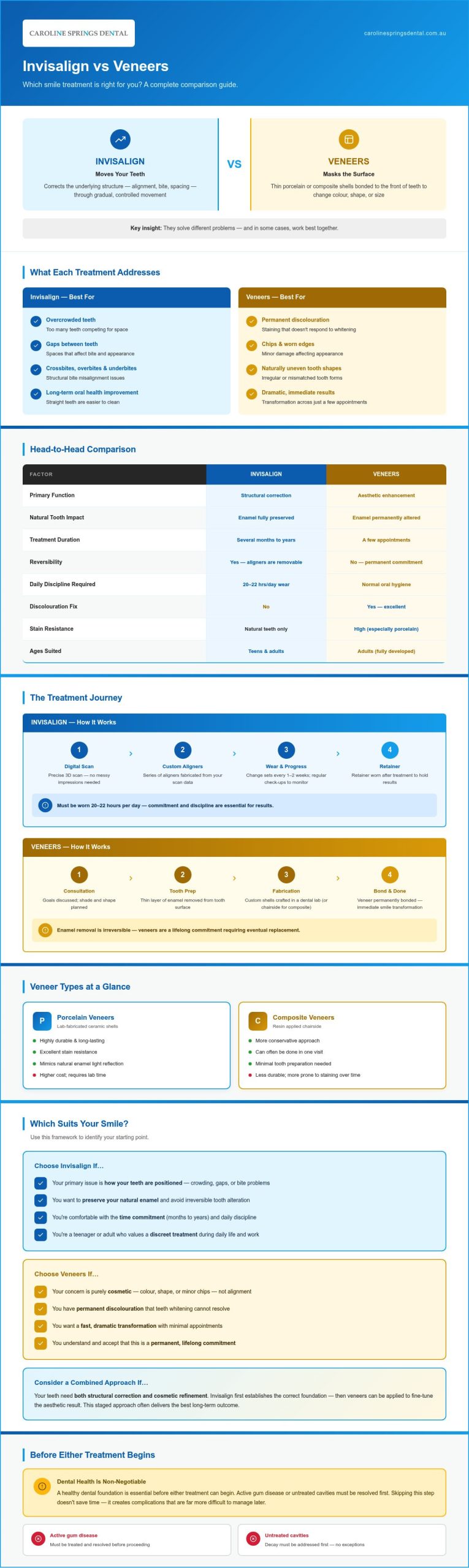
Which Choice Suits Your Smile? A Decision Framework
All the comparisons in the world won’t make the decision for you. What actually cuts through the noise is an honest assessment of your own teeth, your timeline, and your lifestyle. When it comes to Invisalign vs veneers, the right answer isn’t the one that sounds most impressive; it’s the one that genuinely fits your situation.
Start by asking yourself three questions. First, what’s the actual condition of your teeth right now? Second, how much time are you realistically working with? Third, how disciplined are you willing to be about the process? Your answers to those three questions will point you in a clear direction, even before you sit down with a dentist.
Choose Invisalign If…
Invisalign is the stronger choice when the root issue is structural. If your teeth are healthy but sit in the wrong positions, covering them with veneers won’t fix the underlying problem. It’ll simply disguise it, often at the cost of perfectly good enamel. Invisalign is particularly well-suited if you:
- Have an overbite, underbite, crossbite, or significant crowding that affects both your appearance and your bite function
- Want to keep your natural tooth enamel completely intact, with no permanent alterations to your tooth structure
- Are disciplined enough to commit to wearing aligners for 20 to 22 hours each day without exception
- Have a timeline of six months or more before you need results
The lifestyle discipline piece is worth taking seriously. Forgetting to put aligners back in after meals, or leaving them out for long stretches, genuinely slows your progress. If you travel frequently, work irregular hours, or simply know that “out of sight, out of mind” applies to you, factor that in honestly.
Choose Veneers If…
Veneers are the right answer when the problem is cosmetic rather than structural, and when you want a significant aesthetic change in a short timeframe. They’re particularly effective if you:
- Have intrinsic staining or discolouration that doesn’t respond to professional whitening
- Want to change the actual shape, size, or “squareness” of your teeth, not just their alignment
- Are working toward a total smile makeover and want results within weeks rather than months
- Have a specific event, such as a wedding or milestone, on the near horizon
For patients seeking a complete shape transformation, porcelain veneers and composite veneers at Caroline Springs Dental can deliver a dramatic, natural-looking result that whitening and alignment alone simply can’t achieve. It’s also worth knowing that some patients benefit most from a combined approach: straightening first, then refining the aesthetic finish with veneers once the foundation is correct.
None of this replaces a proper clinical assessment. Ready to work out which path suits your smile? Book a consultation at Caroline Springs Dental and get a personalised recommendation based on your teeth, not a generic quiz result.
The Caroline Springs Dental Approach to Cosmetic Care
At Caroline Springs Dental, cosmetic treatment always starts with a simple principle: healthy teeth first, beautiful teeth second. It’s not a marketing slogan; it’s the clinical reality that protects your long-term results. No cosmetic outcome, however impressive it looks on day one, will hold up if it’s built on a compromised foundation. That’s why every patient who walks through our doors, whether they’re weighing up Invisalign vs veneers or simply exploring their options for the first time, begins with a thorough health assessment before any treatment plan is discussed.
One approach that consistently delivers strong outcomes for our patients is a combined, staged plan. Rather than treating cosmetic dentistry as a single-step decision, we’ll often recommend straightening first, then refining. Completing Invisalign treatment before moving to professional teeth whitening or composite bonding means the aesthetic finishing touches are applied to a correctly aligned smile, not one that’s been cosmetically masked. The results are more predictable, more durable, and more natural-looking over time.
This kind of sequenced, health-first thinking is exactly what local patients across Caroline Springs, Taylors Hill, Burnside, and St Albans deserve from their dental team. A face-to-face consultation at our clinic isn’t something you can replicate with an online quiz or a social media before-and-after. Complex cosmetic work requires a trained eye, proper clinical tools, and a genuine conversation about your goals.
Your Personalised Smile Assessment
We use digital imaging during your consultation to give you a realistic preview of potential outcomes before any treatment begins. This isn’t about selling you a dream; it’s about making sure the plan we build together genuinely suits your facial features, your bite, and your lifestyle. We’ll also walk you through long-term maintenance expectations upfront, so your investment in your smile continues to pay off for years to come. There are no surprises and no hidden steps.
Booking Your Consultation in Melbourne’s West
Our clinic is conveniently located for families across Melbourne’s western suburbs, and our team is experienced in caring for patients at every life stage. If you have younger children and you’re thinking ahead about early orthodontics, our children’s dentistry services mean the whole family can be looked after under one roof. For information on health fund arrangements and payment planning, visit our payment options page before your appointment.
Ready to take the first step? Book your consultation at Caroline Springs Dental and get a clear, personalised recommendation based on your actual teeth. A more confident smile starts with one honest conversation.
Your Clearer Smile Starts With One Honest Conversation
Choosing between Invisalign vs veneers isn’t a decision you should make based on trends or what looks impressive on social media. The right treatment is the one that suits your actual teeth, your timeline, and how you want to live your life. Straightening addresses structure; veneers address aesthetics. In some cases, a staged combination of both delivers the most natural and lasting result.
What matters most is getting a clinical assessment from a team that understands both options equally well. Caroline Springs Dental is a private practice serving Melbourne’s western suburbs, with genuine expertise in clear aligner orthodontics and porcelain restorations. Every treatment plan is tailored to your smile, not a template.
Whether you’re in Caroline Springs, Taylors Hill, Burnside, or nearby, you don’t have to figure this out alone. Book your cosmetic consultation at Caroline Springs Dental today and get a clear, personalised recommendation built around your goals. A smile you’re genuinely proud of is well within reach.
Frequently Asked Questions About Invisalign vs Veneers
Can I get Invisalign if I already have veneers?
Yes, in many cases Invisalign can still be used if you have existing veneers, but it does require careful planning. Small attachments are sometimes bonded to teeth during Invisalign treatment to help guide movement, and placing these on veneered teeth carries a small risk of surface damage when they’re removed. Your dentist will assess the condition and placement of your veneers during your consultation to determine whether Invisalign is a safe and practical option for your specific situation.
Is Invisalign cheaper than getting a full set of veneers in Australia?
The cost of both treatments varies considerably depending on the complexity of your case, the number of teeth involved, and the materials used. Neither Invisalign nor a full set of veneers is a minor financial commitment. Rather than comparing price tags in isolation, it’s more useful to consider what each treatment actually delivers for your smile. Caroline Springs Dental offers payment options and health fund arrangements to help make both treatments more manageable, so discussing your budget openly during your consultation is always a good starting point.
Do veneers ruin your natural teeth permanently?
The honest answer is that porcelain veneers do require the permanent removal of a thin layer of enamel, which means the tooth will always need to be covered by a veneer or restoration going forward. “Ruin” is too strong a word for most cases, but the change is irreversible. Composite veneers are a more conservative alternative that typically require minimal or no enamel removal. For the right candidate, veneers are a safe and highly effective option; the key is making sure the decision is made with full understanding of what’s involved.
Will my health fund cover Invisalign or veneers at Caroline Springs Dental?
Health fund cover for both treatments depends entirely on your individual policy and level of extras cover. Orthodontic benefits may apply to Invisalign under some policies, while veneers are generally classified as cosmetic and attract little to no rebate from most funds. Caroline Springs Dental works with a range of health funds, and the team can help you understand what your policy may contribute before treatment begins. Visiting the payment options and health funds page is a practical first step.
Can I just get veneers on my top teeth and Invisalign on the bottom?
This kind of split approach is possible in some cases, and it’s actually a reasonable strategy for patients whose concerns differ between their upper and lower arches. That said, your bite and how your teeth meet together needs to be carefully considered before committing to this plan. Changing the shape of your upper teeth with veneers while simultaneously moving your lower teeth with Invisalign can affect your bite if not sequenced correctly. A thorough clinical assessment is essential before mixing treatments across different arches.
Is the Invisalign process painful compared to getting veneers fitted?
Most patients describe Invisalign as producing mild pressure or tenderness for a day or two after switching to a new set of aligners, which settles quickly. The veneer process involves local anaesthetic during enamel preparation, so the procedure itself is comfortable, but some patients experience sensitivity in the days following, particularly before the permanent veneers are placed. Neither treatment is considered significantly painful by most patients, though individual experiences do vary. Both are manageable with over-the-counter pain relief if needed.
How do I clean my teeth with veneers vs. Invisalign aligners?
With Invisalign, cleaning is straightforward because you remove the aligners to brush and floss as normal. The aligners themselves need a gentle rinse and clean each day to prevent bacteria build-up. Veneers don’t change your oral hygiene routine significantly; you brush and floss as usual, though a soft-bristled brush and non-abrasive toothpaste are recommended to avoid dulling the porcelain surface over time. The key difference is that Invisalign gives you complete access to your natural teeth throughout treatment, which many patients appreciate.
What happens if a veneer chips or an aligner is lost?
A chipped veneer needs to be assessed promptly, as the exposed tooth underneath may be sensitive and vulnerable without its covering. Depending on the extent of the damage, a repair or full replacement may be needed. A lost or damaged Invisalign aligner should be reported to your dentist as soon as possible; in most cases, you’ll be advised to move to your next set of aligners or return to the previous set while a replacement is organised. Keeping a spare set on hand and handling both veneers and aligners with care goes a long way toward avoiding either situation.